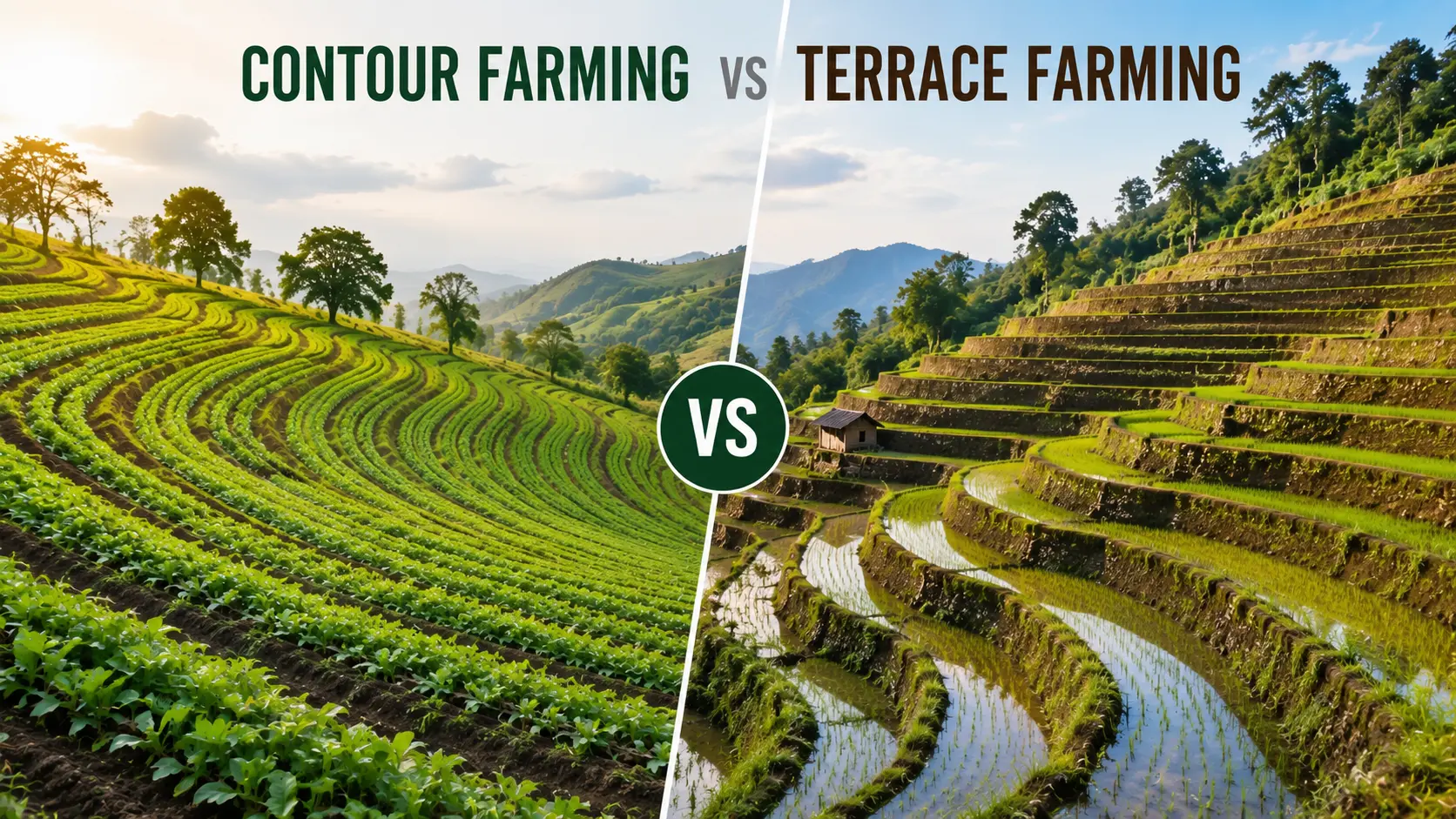
Soil erosion is one of the major problems that farmers encounter, particularly in hill areas. It is caused by heavy rains leading to loss of soil, decreased agricultural productivity, and increased water runoff. This problem has been mitigated by farmers using various land management practices that conserve soil and water as well as improving agricultural productivity.
Of the many practices that can be used in this regard, two of the most efficient ones are contour farming and terrace farming. While both practices aim at preventing soil erosion and moisture retention, there are quite significant differences in terms of the design, implementation, cost, and suitability for specific lands.
Having knowledge of the difference between contour farming and terrace farming enables farmers to apply the practice that is the best for their particular landscape.
This article explains how the two practices work, their benefits and drawbacks, main distinctions, and applicability of each practice in specific conditions.
What Is Contour Farming?
Contour farming is a farming practice whereby plants are cultivated according to the contour line of the terrain.
Contour lines have similar elevations on the farm field. This creates a barrier that ensures that rainwater moves slowly and infiltrates the soil.
In contour farming, there is no reformation of the soil.
How Contour Farming Is Done
When rain occurs in sloping fields, water will flow downhill due to gravity. Traditional farming techniques that use straight rows allow for water runoff to increase erosion.
Contour farming breaks the movement of water flow through small barriers created. These barriers are as follows:
- Slow the movement of water
- Ensure water infiltration
- Prevent soil erosion
- Nutrients conservation
- Soil moisture retention
What Is Terrace Farming?
Terrace farming is a process through which hilly lands are leveled and turned into terraces.
A terrace is like a flat platform used for cultivation of plants and prevents water from sliding downwards.
The terraces can be supported using earth embankments and retaining walls constructed using stones, concrete or living materials.
Terrace farming is common in mountainous areas where it is hard to cultivate.
How Does Terrace Farming Work?
The terraces are constructed so that water does not run down the hillside.
Rather, the rainwater collects on the terraces and then moves to the next terrace.
This significantly decreases following:
- Velocity of water
- Erosion of soil
- Loss of nutrients
- Risk of flooding
Terraces increase water retention in the crop fields.
Difference Between Contour Farming and Terrace Farming
| Feature | Contour Farming | Terrace Farming |
| Land Modification | No major land reshaping | Land is reshaped into steps |
| Suitable Slopes | Gentle to moderate slopes | Steep slopes |
| Initial Cost | Low | High |
| Construction | Simple | Complex |
| Maintenance | Low | Moderate to High |
| Soil Erosion Control | Good | Excellent |
| Water Conservation | Good | Excellent |
| Machinery Use | Easier | Limited on narrow terraces |
| Labor Requirement | Low | High |
| Best Crops | Cereals, legumes, vegetables | Rice, tea, coffee, vegetables, fruits |
Major Difference Between Contour Farming and Terrace Farming
- Land Structure
The structure of the land remains natural in contour farming.
In terrace farming, the structure of the land is altered completely as flat structures are created.
Thus, terrace farming is more appropriate to be used in steep mountains.
- Construction Cost
The cost of construction of contour farming is very low since farmers simply alter the orientation of planting.
The construction cost of terrace farming is very high due to excavation, levelling, construction of retaining wall, drainage and labour.
Therefore, terrace farming is quite expensive than contour farming.
- Suitability for Slope
Contour farming works well on slopes ranging from 2% to 10%.
Steep slopes where contour farming is not enough to prevent erosion should go for terrace farming.
- Soil Protection
Both reduce soil erosion; however, terrace farming protects soil better as water movement gets significantly reduced.
Contour farming suits moderate rainfall areas whereas terrace farming suits heavy rainfall on steep slopes.
- Water Infiltration
Contour rows facilitate water infiltration.
However, terraces hold water for sometime and thus conserve water.
This explains the use of terrace farming in rice cultivation.
- Labor Requirement
Contour farming may be possible without any special labor needs.
Specialized labor is required in building and maintenance terrace farming.
- Types of Crops Suitable
Contour farming is suitable for cultivation of:
- Wheat
- Maize
- Soybean
- Cotton
- Pulse
- Vegetables
Terrace farming is suitable for cultivation of:
- Rice
- Tea
- Coffee
- Grapes
- Apple
- Citrus
- Vegetables
Advantages of Contour Farming
Reduces Soil Erosion
The contour rows reduce erosion by slowing down water flow.
Water Conservation
More time for rainwater to seep into the soil.
Increases Soil Fertility
Less nutrient soil gets washed away.
Low Cost
No major earth moving work required by the farmer.
Mechanization of Agriculture
Farm machines can easily operate on such contours.
Environmentally Sound
Reducing sediment in the rivers and lakes.
Disadvantages of Contour Farming
- Not very effective in case of highly inclined land
- Needs proper contour lines to be aligned
- Heavier rain may cause erosion
- Requires regular maintenance
- Cannot be used in mountains
Advantages of Terrace Farming
Very Good Soil Erosion Prevention
Terraces decrease the amount of soil erosion.
Very Good Water Saving
Every terrace retains water for longer periods of time.
Useful to Make Steep Land Suitable for Cultivation
It is possible to cultivate land that would have remained uncultivated otherwise.
Increases Crops Yield
Better soil conservation results in increased yield.
Flood Prevention
Terrace farming reduces water runoff.
Longevity
Well-managed terraces are productive for many generations.
Disadvantages of Terrace Farming
- Expensive construction process
- Heavy labor requirements for setup
- Maintenance is required
- Reconstruction after rainfall
- Access to machinery may be difficult
Similarities between Contour Farming and Terrace Farming
Although both methods differ, there are common goals shared by both farming practices.
These include:
- Reducing soil erosion
- Improving water retention
- Increasing soil moisture content
- Increasing yield of crops
- Promoting sustainable farming practices
- Avoiding loss of nutrients
- Preservation of the farmlands from degradation
Where is Contour Farming Most Prevalent?
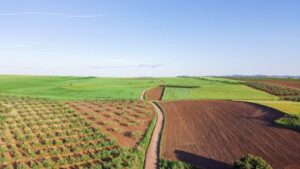
Contour farming is extensively used in regions where the topography is hilly and slopes are not very steep.
These include:
- Central India
- Certain parts of Maharashtra
- Karnataka
- Madhya Pradesh
- Midwest of United States
- Europe
- Australia
It is especially useful where there is seasonal rainfall.
Where Is Terrace Farming Usually Applied?
Terrace farming is widely used in mountainous and hilly areas.
It includes:
- India’s Himalayan regions
- Uttrakhand
- Himachal Pradesh
- North-East India
- Nepal
- China
- Peru
- Philippines
- Indonesia
- Vietnam
All these areas have used terrace farming for a very long time already.
Which Approach Is Better?
There is no one-size-fits-all answer.
It depends on the type of your land.
Use contour farming when:
- Your land has moderate slopes.
- You want to go with the cheaper option.
- You work with tractors or farm machinery.
- You want ease of implementation.
Apply terrace farming when:
- You have a steep slope of land.
- You experience severe soil erosion.
- Water conservation is important.
- You farm rice, tea or coffee.
In addition, many farms usually use contour farming together with other soil conservation methods like cover crops, strip cropping, mulching, and grassed waterways.
Best Practices for Effective Soil Conservation
No matter which approach you choose, here are some good practices you should follow:
- Maintain healthy soil enriched with organic material.
- Use cover crops during off-seasons.
- Practice crop rotation.
- Avoid excessive tillage.
- Implement mulching to conserve moisture.
- Maintain drainage channels.
- Inspect your lands after heavy rains.
Conclusion: Difference Between Contour Farming and Terrace Farming
The importance of knowing the difference between contour farming and terrace farming is crucial when choosing the most appropriate soil conservation technique to apply. The two farming methods share similar objectives of soil conservation but are suitable in distinct environments.
Contour farming is an effective and cost-effective strategy that can help the farmer manage runoff from land with moderate slopes without making any significant changes in the landscape. Conversely, terrace farming turns the hillsides into arable pieces of land with remarkable soil erosion and water control ability despite the high costs incurred in construction and maintenance.
Choosing the best technique involves several considerations including the land slope, climate (amount of rainfall), budget, and crops grown. Adopting appropriate soil conservation practices along with other sustainable strategies such as crop rotation and mulching helps improve soil quality.
FAQs : Difference Between Contour Farming and Terrace Farming
What is the primary difference between contour farming and terrace farming?
The main distinction is that contour farming involves following contour lines naturally on a slope without altering its natural form, whereas terrace farming involves altering steep slopes into flat surfaces in order to retain water.
Which technique is better for reducing soil erosion?
Terrace farming is more effective when it comes to reducing erosion on steep slopes since it considerably reduces the rate of water flow. Contour farming is very effective on gentle to moderate slopes.
Which farming technique is more affordable than the other?
Contour farming is considerably less expensive compared to terrace farming, since no significant alterations are needed.
Are there any terraces where contour farming can also be done?
Yes, it is possible. On some terrains, terraces are formed on steep slopes, and contour farming is practiced within them.
Which plants are ideal for terrace farming?
Plants such as rice, tea, coffee, vegetables, fruits, and many other plants which greatly benefit from water retention are commonly grown on terraces.