
Agriculture in modern times encounters various challenges like decreasing soil fertility, climate change, water scarcity, loss of biodiversity and varying incomes from farming. Modern farmers require techniques which would increase production of crops as well as save natural resources for the coming generations. The best technique receiving global recognition currently is agroforestry.
There are various benefits of agroforestry in agriculture that are much more than just planting trees along crops. It is the technique where trees, shrubs, crops and even animals form an integrated system in agriculture. It is a system which helps to build a better ecosystem, increasing productivity and profitability on farms.
If you are a small-scale farmer, commercial farmer, agricultural student or any individual interested in sustainable agriculture, then knowledge about the benefits of agroforestry in agriculture will be useful for you. Here are the advantages of agroforestry in agriculture.
What Is Agroforestry?

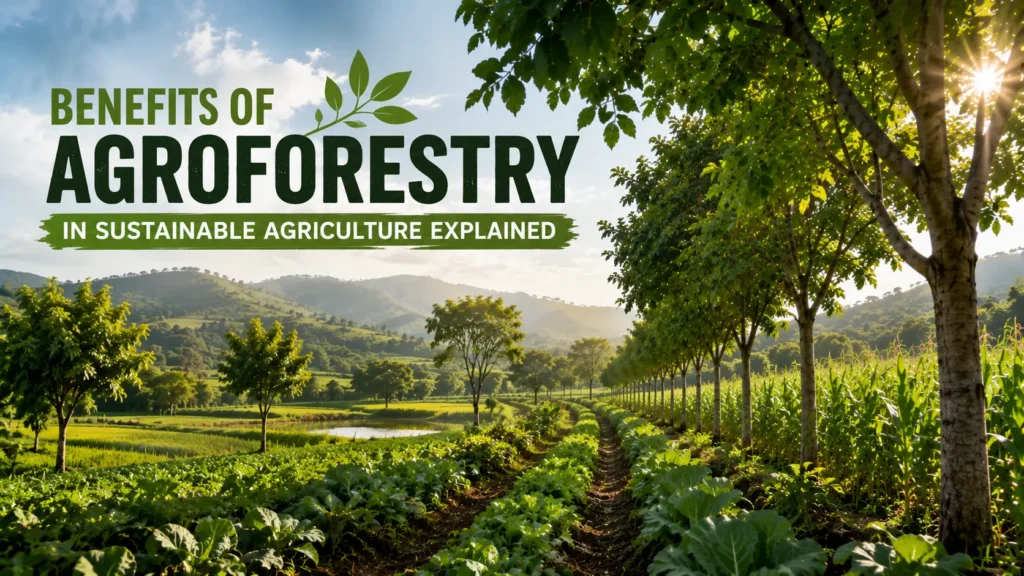
Agroforestry is the practice where trees or shrubs are purposefully grown together with agriculture crops or livestock. Unlike other practices where forests and farms are kept separate from one another, agroforestry seeks to integrate both for the best of each.
Examples include are as follows:
- Growing fruit trees alongside vegetables
- Growing timber trees along farm borders
- Silvopastures with livestock grazing under trees
- Establishing windbreaks around crops
- Alley cropping with rows of trees amidst cultivated crops
Top Benefits of Agroforestry in Agriculture
1. Increases Soil Fertility
Good soil quality is the cornerstone of efficient agriculture.
Trees enhance the soil with the addition of organic matter due to fallen leaves, branches, and roots, which are further broken down by bacteria.
Best advantages are:
- High organic carbon levels
- Increased microbial activity
- Nutrient recycling
- Earthworm population growth
- Overall increase in soil fertility
Nitrogen fixing trees such as Gliricidia and Leucaena naturally increase the level of nitrogen in soil, reducing the need for artificial fertilizers.
2. Protects from Soil Erosion
Intense rains and wind can result in erosion of precious topsoil.
The roots of trees hold soil securely, while their canopy protects the soil from impact by raindrops. The windbreak trees prevent high speed wind from blowing, minimizing soil erosion in open fields.
This directly helps farmers to:
- Protect fertile topsoil
- Prevent nutrient loss
- Maintain productive farmland
- Minimize sedimentation in rivers
3. Saves Water
With time, water conservation is gaining increasing importance due to the increase in the frequency of droughts.
Agroforestry aids in maintaining moisture in the soil through the following ways:
- Shading and therefore preventing water loss via evaporation
- Allowing water penetration into the soil
- Promoting groundwater recharge
- Increasing the ability of soil to hold moisture
Therefore, less water will be required to irrigate the crops hence healthier crops in times of drought.
4. Encourages Biodiversity
One of the main advantages of agroforestry in agriculture is providing habitat for wildlife.
Trees attract:
- Birds
- Bees
- Butterflies
- Pollenating insects
- Predatory insects
This provides natural pest management and increases the rate of pollination without using pesticides.
Biodiversity makes the farm resistant to diseases.
5. Counters Climate Change
Both agriculture and climate change influence each other.
Trees take carbon dioxide from the air and store it in their trunks, branches, roots, and soil.
The contribution of agroforestry to this is as follows:
- Carbon sequestration
- Decreasing greenhouse gases
- Creating climate smart farms
- Reduction in heat stress of crops
Most governments are nowadays encouraging the practice of agroforestry.
6. Enhances Farm Revenue
Conventional agriculture relies on one or two crops per season.
Agroforestry produces various sources of income all year long.
A farmer capable of generating revenues from:
- Fruits
- Timber
- Fuelwood
- Medicinal plants
- Bamboos
- Nuts
- Honey
- Fodder
The diversified source of income eliminates risks associated with poor performance of one crop.
7. Minimizes Agricultural Expenses
Trees offer natural resources that decrease production costs.
Among them are as follows:
- Natural fertilizers from leaves
- Natural shade, which cuts down irrigation costs
- Biological control of pests
- Reduction of fertilizer needs
- Wind shelter
All of the above eventually increase the profitability of the farm.
8. Protects Crops from Harsh Weather Conditions
The impact of climate change caused an increase in the number of heat waves, storms, and winds.
Trees serve as a natural shield due to the following reasons:
- Reduction of wind speed
- Providing shade
- Reduction of temperature of the fields
- Protection from heavy rains
The protective features ensure stable crop yield.
9. Facilitates Livestock Farming
Agroforestry is useful for livestock as well.
Trees provide:
- Shade during hot periods of the year
- Fodder for cattle
- Wind shelter
- Grazing area
Healthy animals usually produce more milk, meat, etc.
10. Better Air Quality
The natural filters of trees remove pollutants and produce oxygen.
They also trap dust particles in farmland, providing a cleaner surrounding for farmers, workers, and people living around such farms.
Better air quality makes for sustainable farms.
Various Agroforestry Systems

Depending on the nature of farm practices, agroforestry systems vary.
Alley Cropping
In this system, trees are intercropped with crops for improving soil fertility and reducing erosion.
Silvopasture
Here, trees, pastures, and livestock are combined for reciprocal gains.
Forest Farming
Valuable crops are grown under trees in this system.
Such crops include herbal medicines, spices, and mushrooms.
Windbreaks
Trees are grown in the fields where they serve as protective barriers from the wind.
Riparian Buffers
These involve growing trees alongside rivers and streams.
Economic Benefits of Agroforestry
Agroforestry brings not only environmental but economic benefits too.
Such benefits are:
- Regular harvests all year round
- Timber production for years ahead
- Less need for chemicals
- More productive land
- Increased tolerance of crop failure
Various sources of income ensure economic stability in any case.
Environmental Advantages of Agroforestry
The environmental effects of agroforestry are enormous.
It enables following:
- The restoration of degraded lands
- Carbon sequestration
- Enhancing wildlife habitats
- Pollution reduction
- Watershed protection
- Ecosystem health
- Sustainable agriculture
These advantages will lead to better landscapes and agricultural productivity.
Challenges of Agroforestry

Even though there are many benefits of agroforestry in agriculture, the farmer should know about the challenges as well.
Here are some common disadvantages:
- Increased upfront costs
- More time before the trees start making money
- Proper planning required
- Compete for light when not well-managed
- Low technical knowledge in some places
These disadvantages can be overcome by choosing appropriate trees and practicing proper techniques.
Best Trees for Agroforestry
The choice of the best trees depends upon the local climatic conditions and purpose of farming.
Some common options include:
- Neem
- Mango
- Guava
- Drumstick (Moringa)
- Bamboo
- Teak
- Eucalyptus (suitable conditions)
- Leucaena
- Gliricidia
- Acacia
Choosing native or locally adapted species usually results in the best outcome.
Successful Strategies for Agroforestry
For ensuring success:
- Select tree varieties that will suit your crops.
- Maintain proper spacing to minimize competition.
- Regular pruning will enhance sunlight access.
- Use nitrogen-fixing varieties wherever feasible.
- Keep an eye on soil fertility and water content.
- Integrate crop and tree diversification.
- Have proper harvest scheduling to maintain steady income
Proper management will help farmers reap both ecological and economic advantages.
FAQs related to the benefits of Agroforestry in Agriculture
What are the benefits of agroforestry in agriculture?
Some of the advantages include increased soil fertility, water retention, prevention of erosion, increased biodiversity, carbon sequestration, income diversification, reduction in farm production cost, and increased resilience to climatic changes.
Is agroforestry a good approach to small-scale farmers?
Yes. Some ways in which agroforestry is beneficial to small-scale farmers involve planting fruit trees, timber trees, fodder crops, or even nitrogen-fixing plants among the agricultural produce to increase production levels and earn some extra income.
Can agroforestry increase crop yield?
If well planned, agroforestry could enhance crop yields by improving soil conditions, ensuring water retention, protection from wind damage, and attracting useful insects. Proper planning on the types of trees to plant is important.
Why is agroforestry environmentally friendly?
Conclusion
In addition to the increased output of food products, the benefits of agroforestry in agriculture reach far into improving soil health, saving water, minimizing erosion, protecting species diversity, and generating diverse sources of income. Agroforestry helps farms cope with the impact of climate change and become sustainable and productive over a long period.
As the need for farming in an environmentally friendly way becomes more apparent, agroforestry offers itself as an approach that combines financial viability with environmental sustainability. Regardless of whether a small farm or a large enterprise adopts agroforestry, it will be beneficial in terms of creating healthier soils, ecosystems, and profitable agricultural enterprises for many years to come.