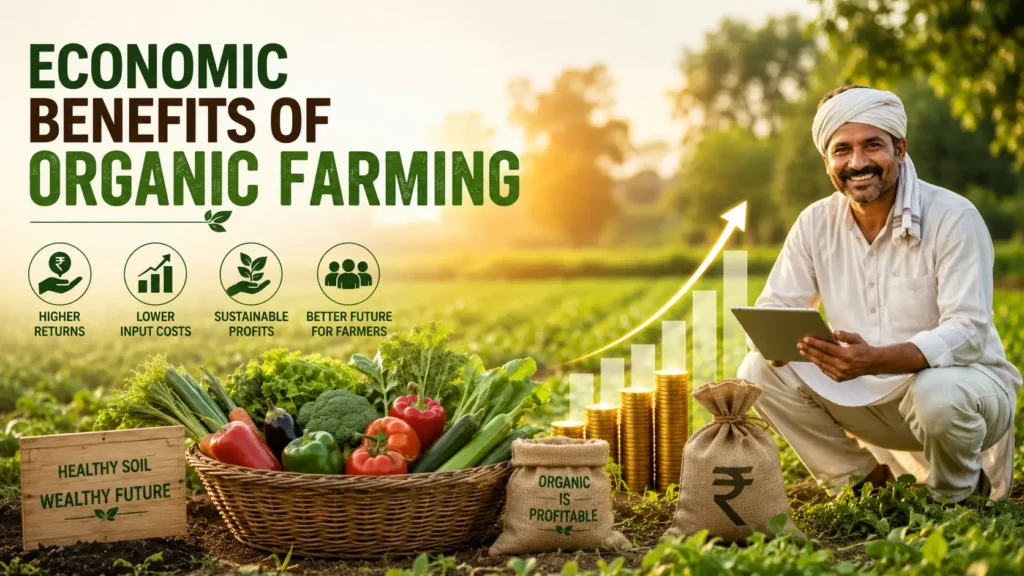
Organic farming has come a long way from being just a marginal farming approach. Currently, we are exploring the economic benefits of organic farming that benefit farmers, consumers, industries, and the environment in equal measure. The increasing demand for chemical-free products, the presence of government regulations, and the rising awareness regarding sustainable farming systems have ensured that organic farming is amongst the fastest-growing segments of agriculture.
Whereas many people concentrate on the ecological aspects of organic farming, the economic side should not be overlooked. Contrary to what most farmers believe regarding organic farming reducing profits, scientific studies and actual experiences prove that a well-run organic farm is capable of turning into a highly profitable farm through cost reduction, increased price premiums, and soil productivity.
This manual is intended to help you understand the economic benefits of organic farming and how it enables farmers make sustainable incomes in the process.
What Is Organic Farming?

Organic agriculture refers to a farming method that does not use chemical fertilizers, pesticides, genetically modified organisms (GMOs), and plant growth regulators. It rather depends on nature through the following:
- Compost and farmyard manure
- Rotation of crops
- Green manure
- Pest management using natural methods
- Soil fertility enhancement
- Microbes
The purpose is to grow healthy food crops and conserve soil fertility, biodiversity, and nature balance.
Why The Economic Benefits Of Organic Farming Are Important
The cost of agriculture continues to rise. Increases in the cost of fertilizers, fuel, labor, and uncertainty in climatic conditions make agriculture more difficult each passing year.
Organic agriculture helps address many of these problems through a reduced dependency on costly external inputs and improving the productivity of farmlands.
Rather than just concentrating on achieving maximum output during a particular season, organic agriculture strives to generate consistent profit for many years.
1. Reduction In Production Costs
The most important economic aspect of organic agriculture is the reduction in costs incurred in the process of production.
Agricultural inputs in conventional agriculture include:
- Chemical fertilizers
- Pesticides
- Herbicides
- Promotors of plant growth
These inputs make up a substantial part of the farmer’s expenditures.
In organic agriculture, many purchased inputs are substituted by farm-made inputs like:
- Compost
- Manure from cow dung
- Vermicompost
- Plant residues
- Green manure
- Biofertilizers
The farmer, thus, spends less money on external agricultural inputs.
Long-Term Savings
Although switching over to organic agriculture can initially be costly, the recurring expenses are usually reduced afterwards.
Decrease in operational costs results in higher profitability of the farm.
2. Premium Market Prices
Products that are organic usually fetch prices which are higher compared to products which are conventionally grown.
The reason consumers are willing to spend extra is due to the following reasons:
- Chemical free food products
- Environmental friendly processes
- High-quality food products
- Sustainable production processes
Some of the common organic products that command premium prices include:
- Fruits
- Vegetables
- Rice
- Wheat
- Spices
- Tea
- Coffee
- Pulses
- Millets
Even small price premiums can result in large increases in overall farm incomes.
3. Increasing Consumer Demand
There are many factors which are leading to the continuous expansion of organic foods around the world.
Some of the key drivers include:
- Health conscious customers
- Increased environmental consciousness
- Clean label food products
- E-commerce food companies
- Export opportunities
Increased demand results in better markets for the farmers.
4. Improved Soil Health Ensures Greater Productivity
Healthy soil is a vital resource for the farmer.
Organic farming ensures healthy soils through:
- Greater organic content
- Increased presence of beneficial microorganisms
- Higher earthworm presence
- Enhanced water retention
- Improved nutrient availability
As opposed to chemically-based systems that may gradually lead to deterioration of soil, organic farming leads to soil improvement.
Healthy soil contributes to:
- Greater crop resistance
- Reduced use of fertilizers
- Increased stable production
- Decreased land degradation
Such benefits ensure economic gains in the long run.
5. Decreased Need for Expensive Fertilizers
World fertilizer prices may vary greatly depending on:
- Energy prices
- Supply chain disruptions
- International trade
- Geopolitical issues
The farmers practicing organic methods are less exposed to such risks due to their reliance on locally available sources of nutrients.
Thus, the farm income becomes more stable in times of increasing agricultural inputs’ prices.
6. Increased Profit Margins
Profit is determined by two factors:
- Revenue
- Costs
Organic farming increases both.
Even if there is an initial decrease in yields during the transition phase, the farmer may earn more due to:
- Lower costs of production
- Higher selling prices
- Access to premium marketplaces
7. Improved Water Conserving Saves Money
Water is getting more costly in many agriculture-based regions.
Organic soils have high levels of organic material, making it possible for them to:
- Retain moisture longer
- Irrigate less often
- Improve water infiltration
- Lessen water runoff
Less irrigation will mean:
- Less money spent on electricity
- Lower diesel bills
- Decreased pump repair costs
This leads to better financial performance of the farm business.
8. Reduced Pest Management Costs
Healthy environments are capable of supporting many insects that control pests on crops.
Organic farming ensures biodiversity by:
- Preserving pollinating insects
- Beneficial insects
- Birds
- Soil living organisms
Often, farmers use:
- Products based on neem
- Biological insecticides
- A diverse crop mix
- Natural predators
All this may help cut down the cost of purchasing costly chemical pesticides.
9. Exporting Possibilities Grow
Numerous countries purchase certified organic products.
Main exportable products are:
- Organic spices
- Tea
- Coffee
- Cotton
- Rice
- Herbs
- Oilseeds
Certified organic products usually fetch better prices in international markets.
10. Government Assistance and Incentives
The following ways can be used by many governments to promote organic farming:
- Training sessions
- Certification support
- Financial incentives
- Subsidies
- Education of farmers
- Research assistance
All these efforts help make organic farming financially more attractive and make farmers consider switching to this approach.
Farmers must consult the agricultural department in their region about current programs.
11. Increased Resilience of Farms in the Context of Climate Change
Climate change leads to increased frequency of adverse climatic phenomena.
Organic farms usually have healthy soil which:
- Keeps water during drought
- Improves water drainage during rains
- Prevents erosion
- Provides more developed root system
Increased resilience of the farm will help farmers save from financial losses caused by unpredictable weather.
12. Various Sources of Income
Organic farms are usually diverse.
Rather than focusing on one product only, farmers can produce:
- Fruits
- Vegetables
- Cereals
- Meat
- Chicken
- Milk
- Honey
- Medicinal herbs
- Manure
13. Improved Value Addition Opportunities
There are opportunities to earn extra money from value addition from organic produce.
Some examples include:
- Organic flour
- Pressed oils
- Tea leaves
- Organic pickles
- Dehydrated fruits
- Spices
- Ready to cook meals
Value addition takes place before reaching the end consumer hence improves profit margins.
14. Improved Brand Value
Customers are more likely to favor organic farms which adopt sustainable agricultural practices.
There is an opportunity to establish brand value through:
- Transparency of the farm
- Traceability
- Sustainable production methods
- Responsiveness to the environment
There will be chances of:
- Client loyalty
- Repeat business
- Better prices
- Direct marketing to customers
15. Reduced Cost of Restoring Degraded Land
Continuous application of chemicals reduces soil fertility and other components of the soil.
It is costly to restore degraded land.
Organic farming assists in maintaining:
- Fertility of soil
- Diversity of microbes
- Balanced nutrients
- Healthy soil structure
It is cheaper to prevent land degradation than restoring it.
Economic Challenges during Transition
Transition to organic farming does come with some hurdles for the farmers.
Challenges during this process include:
- Low yields during the transition phase
- Costs associated with certification
- Acquiring skills to farm organically
- Difficulty in accessing premium markets before certification
Nevertheless, most of these challenges lessen over time due to experience and improved soil condition.
Careful planning and proper training go a long way towards making the transition easier.
Suggestions to Enhance Economic Benefits of Organic Farming

There are a number of ways for farmers to improve their profit margins in organic farming:
- Improving soil fertility by use of compost and green manure.
- Growing different crops to spread risks.Practicing crop rotation to improve natural fertility.
- Selling produce directly to customers via farmers’ markets or internet platforms.
- Joining FPOs or cooperatives.
- Certifying the produce if selling to premium markets.
- Exploring value addition like producing food and herbal items.
- Keeping accurate records of cost and profits on the farm.
- Using efficient irrigation systems to reduce water cost
Economic Myths Surrounding Organic Farming
Myth 1: Organic farming will be less profitable.
Reality: Reduced inputs costs and increased product prices enhance overall profitability.
Myth 2: Organic farming suits small scale farms only.
Reality: Farms of different sizes can adopt this type of farming with proper management.
Myth 3: People are not willing to spend extra money on organic food.
Reality: There is a high number of people that prefer certified organic foods due to health issues.
Myth 4: Organic farming cannot support the increasing population in the world.
Reality: The productivity of this type of farming depends on many factors like crops selected, management style, climatic conditions and soil fertility. Research and innovations are improving organic farm productivity.
Future Economic Opportunities of Organic Farming
There is a continued growth in demand for sustainable production of food around the globe. There is a preference of consumers, retailers, restaurants and food processors towards organic food products.
Technology including precision irrigation systems, farm management tools, improved compost technology and biological pest control is making organic farming more efficient and profitable.
With the continued growth of environmental sustainability consciousness, organic farming is becoming important part of agriculture industry.
Conclusion
Benefits of organic farming to farmers are numerous. Not only is the price premium the only advantage of this type of agriculture; the low cost of production, healthy soils, efficient use of water, diversification of income sources, increased demand for produce, and increased long-term productivity of land makes organic farming appealing to many farmers.
Although switching to organic farming takes time, effort, and patience, the long-term gains usually make up for the initial difficulties. As the demand for organic products grows globally, the future looks bright for farmers willing to develop their businesses by using sustainable methods.
A combination of proper farm management and organic methods may lead to the development of an economically profitable and ecologically sustainable farming system.
(FAQs) : Economic Benefits of Organic Farming
Is organic farming more profitable than conventional farming?
Yes, it is. Even though the yield tends to be lower initially, reduced production cost and premium prices can make organic farming more profitable over time.
Why are organic products sold at higher prices?
It is because of stringent regulations for organic products, certification requirements, and high consumer preference for sustainable products that are free from chemicals.
Is organic farming less costly in terms of production?
Yes. Organic farming relies less on artificial fertilizers and pesticides and uses natural means like crop rotations and composting.
Are small farmers financially able to profit from organic farming?
Definitely. By reducing production cost, adding diversification in the products being cultivated, reaching out to niche markets, and engaging in direct marketing, small farmers can earn good money through organic farming.
Can organic farming be conducted for exports?
Yes. Organic products such as spices, tea, coffee, rice, herbs, and cotton are popular and have a premium price in the international market.