Water management is a vital element of modern agriculture. With farmers dealing with inconsistent rainfall, escalating irrigation costs, and water scarcity in general, the need for efficient irrigation techniques is more pressing than ever. Sprinkler irrigation is one such method that allows water to be applied to agricultural land in a controlled way.
This is a system that is extensively used for the cultivation of field crops, vegetables, fodder, and so on. When it is well designed and well operated, it can lead to improved water distribution, reduced requirement for land leveling, and more efficient crop production.
What is Sprinkler Irrigation?
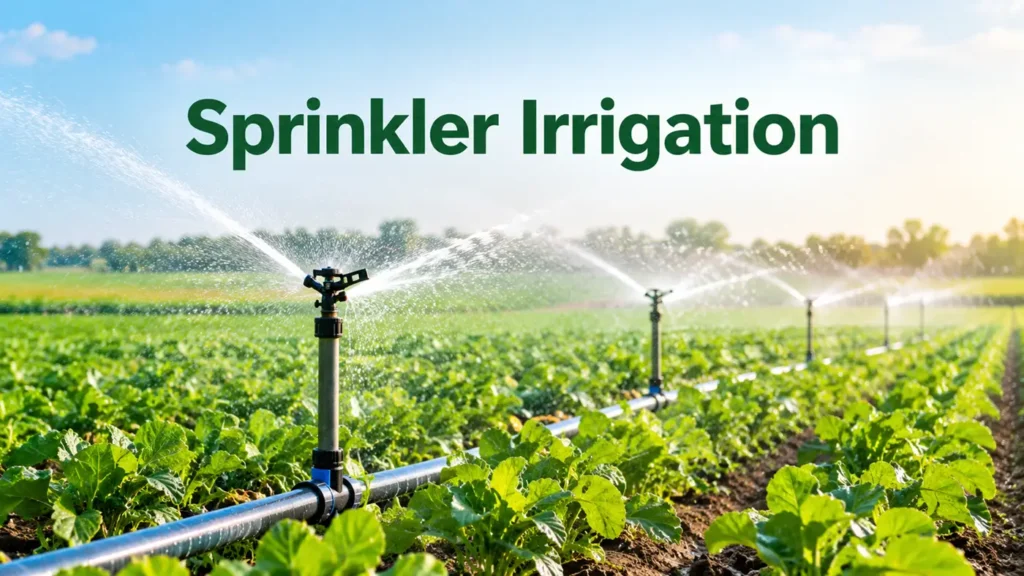
Sprinkler irrigation is a method of watering crops in which water is sprayed into the air through specially designed nozzles and falls onto the soil and plants in the form of droplets, similar to rainfall.
The system will typically employ pipes, sprinklers, and a pump (or some other suitable pressure source) to deliver the water across the field. The application rate of water has to be suitable for the soil’s capacity to take it in; otherwise, you’ll get excessive runoff and surface ponding.
Sprinkler irrigation is quite different from surface irrigation in that the water is delivered from above rather than flowing over the soil. It is appropriate in a given situation depending on the crop, the soil, the wind, the water, and the installation costs.
Components of a Sprinkler Irrigation System
A typical sprinkler irrigation system consists of the following components:
- Water Source: Water will be drawn from a suitable source (well, reservoir, farm pond, etc.).
- Pumping Unit: A pump provides the pressure required to move water through the pipes and sprinkler nozzles. Some systems may use other suitable pressure sources.
- Main Pipeline: This pipe carries water from the source to the irrigation area.
- Sub-Main and Lateral Pipes: These distribute water from the main pipeline to different sections of the field and sprinkler heads.
- Sprinkler Heads or Nozzles: These release water into the air and distribute it over the target area.
- Valves and Pressure Regulators: These control the flow of water and assist in maintaining the appropriate operating pressure.
- Filters: Depending on the water quality and the requirements of the equipment, filters will help to remove any particulates that could clog the nozzles.
- Fittings and Connectors: These join the different components and help ensure that the system operates correctly.
How Does Sprinkler Irrigation Work?
The working principle of sprinkler irrigation involves pressurizing water and distributing it through a network of pipes.
First, the water is taken from the source and fed into the pipeline system (a pump will normally be used to provide the necessary pressure). It then flows through the lateral pipes and reaches the sprinkler heads.
The nozzles spray the water into the air where it breaks up into droplets which then fall over the crop and soil. The sprinkler heads can be of a rotating type, or they can be fixed. The way they’re positioned, the spacing between them, the pressure, and the discharge rate will all have an effect on the uniformity of water application to the field.
Farmers must adjust irrigation duration and frequency according to crop water requirements, soil moisture, weather conditions, and the growth stage of the plants.
Types of Sprinkler Irrigation Systems
Portable Sprinkler System
In a portable system, the pipes and sprinklers can be moved from one area of the field to another. That gives the farmer the flexibility to irrigate different areas of their field using the same kit.
Semi-Permanent Sprinkler System
In this arrangement, some components, such as the main pipeline, remain fixed, while lateral pipes and sprinkler units can be moved when required.
Permanent Sprinkler System
A permanent system has pipes and sprinkler heads at fixed locations. It can be appropriate for farms or cultivated land that require regular irrigation (though the initial installation cost will be higher).
Centre Pivot Irrigation
A center pivot system uses a long pipe on a series of wheeled towers that rotates around a central point and irrigates out from that point in a circular pattern. It’s very commonly used on large agricultural fields.
Rain Gun Irrigation
Rain guns are large sprinkler devices that discharge water over a relatively wide area. They can be used for crops such as fodder and sugarcane where the equipment, water supply, and operating conditions are suitable.
Advantages of Sprinkler Irrigation
Efficient Water Distribution
A well-designed sprinkler system will distribute water fairly evenly over the field, which in turn will allow the farmer to control the amount of water applied and can lead to reduced losses as opposed to poor surface irrigation.
Less Land Levelling
Sprinkler irrigation can be used on gently sloping or uneven land without the need for the extensive leveling that some forms of surface irrigation do.
Reduced Soil Erosion
When the application rate is appropriate for the soil, sprinkler irrigation can reduce the runoff and erosion that would otherwise occur with excessive surface water flow.
Suitable for Different Crops
The system can be adapted to many crops, including wheat, maize, pulses, groundnut, vegetables, fodder crops, and selected fruit crops.
Reduced Labour Requirements
Once installed, sprinkler irrigation can reduce the labor required for manual watering. Automated systems can further simplify irrigation operations.
Better Control Over Irrigation
Farmers can vary the timing, length, and rate of irrigation according to crop needs and the prevailing weather.
Adaptability to Different Fields
Portable and movable systems can be used on different plots, whereas the center pivot and linear move systems are capable of irrigating large areas of agriculture.
Potential for Fertilizer Application
Some sprinkler systems can be used to apply water-soluble fertilizers via the irrigation water. This does, of course, require the appropriate equipment, the right product, and a degree of management.
Disadvantages of Sprinkler Irrigation
Sprinkler irrigation also has certain limitations.
- High Initial Investment: Pumps, pipes, sprinkler heads, and other equipment can be expensive to install.
- Energy Requirements: Pumping water under pressure will increase your electricity or fuel bill.
- Wind Interference: Strong winds will distort the spray pattern and lead to an uneven distribution of water.
- Evaporation Losses: Some water will, of course, evaporate prior to it reaching the soil, especially in hot, dry weather.
- Maintenance requirements: nozzles, filters, pipes, and connections all require regular inspection and cleaning.
- Risk of Plant Diseases: Wet foliage can promote certain fungal diseases in susceptible crops under suitable disease conditions.
- Water Quality Concerns: Sediment and other impurities may clog nozzles or damage equipment if water is not adequately managed.
Crops Suitable for Sprinkler Irrigation
Sprinkler irrigation can be used for a wide range of agricultural crops, depending on local conditions and system design.
Common examples include:
- Cereal Crops: Wheat, maize and barley.
- Pulses: Chickpea and other suitable pulse crops.
- Oilseed Crops: Groundnut and selected oilseed crops.
- Vegetables: Onion, leafy vegetables and other crops suited to overhead watering.
- Fodder Crops: Grasses and fodder crops grown for livestock.
- Selected Fruit Crops: Certain fruit crops can be irrigated using suitable sprinkler arrangements.
The best irrigation method varies according to crop water requirements, soil infiltration, local climate, water availability, and the potential effects of wetting plant leaves.
Difference Between Sprinkler Irrigation and Drip Irrigation
Sprinkler and drip irrigation are both methods of applying water in a controlled manner, but they differ in how water reaches the plants.
Sprinkler irrigation sprays water over the crop and soil surface, distributing it like rainfall. It is useful for irrigating larger areas and crops planted relatively close together.
Drip irrigation delivers water very slowly in the root zone via emitters on the pipe or tube. It’s often the irrigation method of choice for orchards, vegetables, and crops in rows.
Neither method is the best in every situation. The farmer has to compare the installation costs, the crop requirements, the soil conditions, the water quality, and the expected operating costs before deciding which system to go for.
Tips for Maintaining a Sprinkler Irrigation System
Regular maintenance will, of course, help to ensure that the system is distributing the water effectively.
- Inspect the pipes and the connections for leaks.
- Clean the sprinkler nozzles and filters in accordance with the manufacturer’s instructions.
- Check the operating pressure to make sure the sprinklers are operating within their recommended range.
- Check the spray pattern for blockages and for even distribution.
- Avoid irrigation during periods of strong wind if at all possible.
- Adjust irrigation schedules according to rainfall, soil moisture, and crop needs.
- Store portable equipment properly when it is not in use.
Role of Sprinkler Irrigation in Sustainable Agriculture
Sprinkler irrigation can be used to support sustainable agriculture by enabling more precise application of water. It can be a very useful system where land is difficult to level or where you want to apply water in a more rainfall-like manner.
It doesn’t automatically save water, though. Its performance is dependent on good design, good maintenance, good irrigation scheduling, wind conditions, and the quality of the water being used. You have to pick the right irrigation method for the particular farming conditions you’re in if you’re going to get good results.
FAQs about Sprinkler Irrigation
Sprinkler irrigation is an important agricultural technique that distributes water through pressurized pipes and sprinkler nozzles. Its major advantages include controlled water application, reduced land-leveling requirements, adaptability to different crops, and the potential to reduce labor.
Despite the advantages it offers, the system does require an initial capital outlay, energy for pumping (in most cases), and, of course, regular maintenance. It can be used very effectively as part of modern farming practice if you select the right equipment and irrigate according to crop and soil requirements.