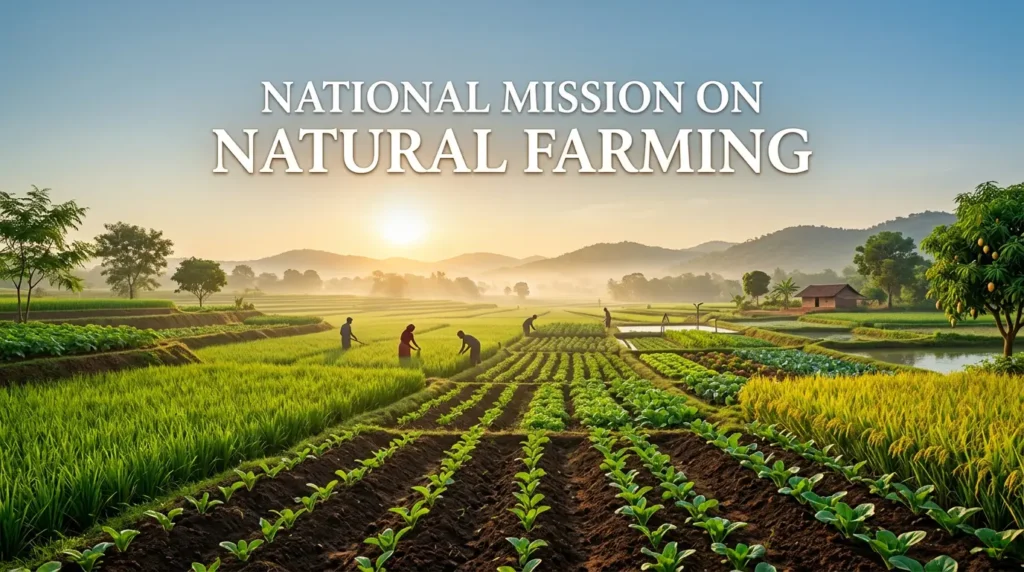
Agriculture is one of the most important sectors of the Indian economy, providing livelihoods to millions of farmers. However, excessive dependence on chemical fertilizers and pesticides, rising input costs, soil degradation, and environmental challenges have increased the need for sustainable farming practices. To encourage environmentally responsible agriculture, the Government of India introduced the National Mission on Natural Farming (NMNF). The mission aims to promote natural farming practices, reduce farmers’ dependence on externally purchased inputs, and improve soil health through locally available natural resources.
What is the National Mission on Natural Farming?
The National Mission on Natural Farming (NMNF) is a standalone Centrally Sponsored Scheme launched under the Ministry of Agriculture and Farmers Welfare. It was approved by the Union Cabinet on 25 November 2024, with a total financial outlay of Rs. 2,481 crore, comprising Rs. 1,584 crore as the Central Government share and Rs. 897 crore as the States’ share, for the period up to the end of the 15th Finance Commission cycle in March 2026.
The mission promotes natural farming as a nature-based agricultural approach that relies on locally available resources, biological processes, livestock integration and diversified cropping systems. It encourages farmers to prepare and use natural bio-inputs on their farms instead of depending heavily on externally purchased agricultural inputs.
Objectives of the National Mission on Natural Farming
Promotes Sustainable Agriculture: The mission encourages farming practices that work with natural ecological processes and support long-term agricultural sustainability.
Reduce Cultivation Costs: By promoting on-farm preparation and use of natural bio-inputs, the mission aims to reduce farmers’ dependence on purchased agricultural inputs and lower production costs.
Improves Soil Health: Natural farming practices aim to support soil biological activity, organic matter, and soil fertility.
Encourage Livestock Integration: Promote integrated agriculture and animal husbandry (preferably with locally adapted cattle breeds).
Strengthen Agricultural Research: Strengthen agricultural research via the ICAR institutions, the Krishi Vigyan Kendras, and the agricultural universities.
Develop Certification and Branding: It aims to establish scientifically supported standards and farmer-friendly certification procedures for naturally grown chemical-free produce, along with a national brand.
Major Features of the Mission
Formation of Natural Farming Clusters: The mission envisages implementation through 15,000 clusters, covering approximately 7.5 lakh hectares. These clusters are intended to help farmers adopt natural farming practices collectively and access training and support.
Farmer Awareness and Training: The mission aims to make around one crore farmers aware of natural farming through demonstrations, training programs and field-level guidance.
Bio-Input Resource Centres: It envisages establishing 10,000 need-based Bio-input Resource Centers (BRCs) to improve farmers’ access to natural farming inputs. These centers may be managed by farmer groups, FPOs, cooperatives, SHGs, and local entrepreneurs.
Model Demonstration Farms: Demonstration farms help farmers understand natural farming methods through practical field experience and local examples.
Farmer Incentives: The mission envisages an output-based incentive of Rs. 4,000 per acre per year for two years, subject to the scheme’s conditions, to support participating farmers in adopting natural farming, preparing inputs, and related activities.
Natural Farming Practices Promoted Under NMNF
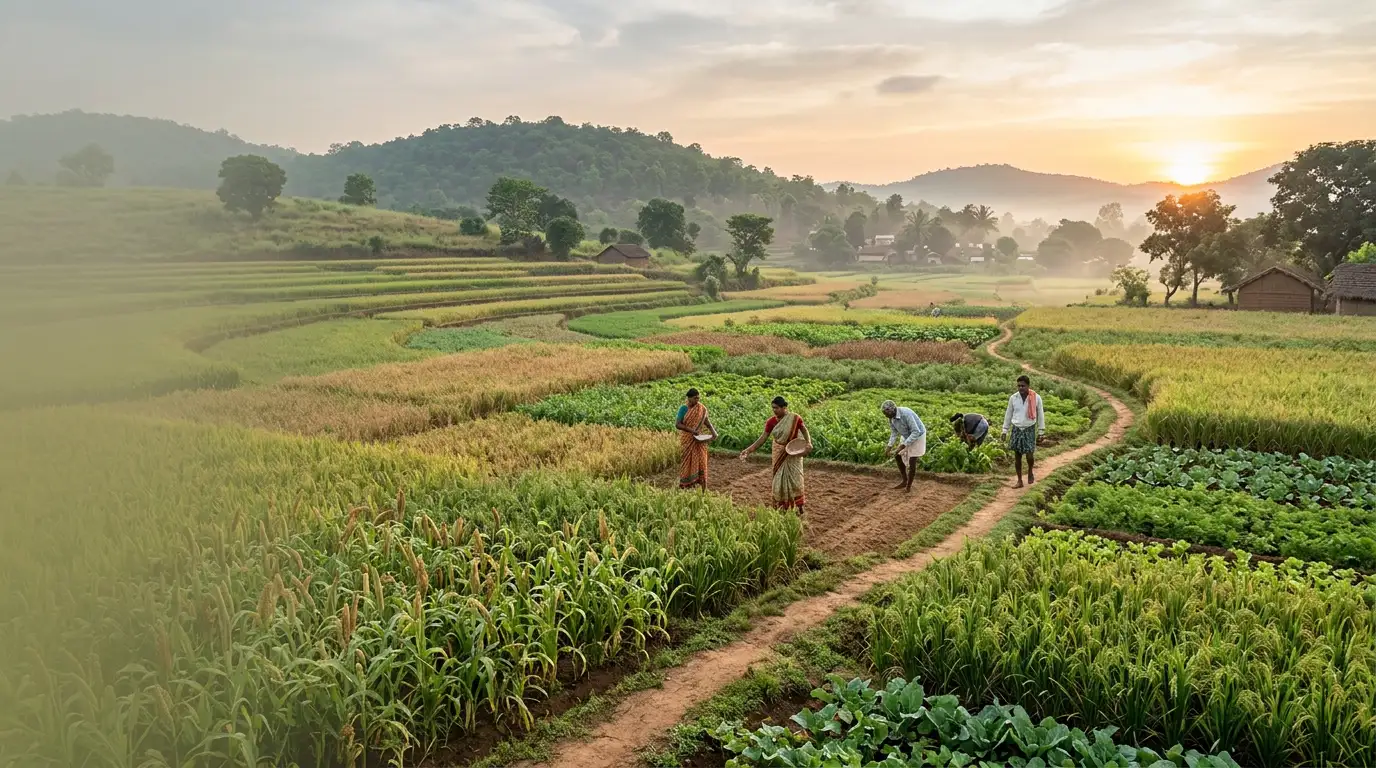
Beejamrit: Beejamrit is a traditional seed-treatment preparation made using locally available natural ingredients. It is used to treat seeds before sowing as part of natural farming practices.
Jeevamrit: Jeevamrit is a fermented microbial preparation commonly made using cow dung, cow urine, jaggery, pulse flour, soil, and water. It is used as a biological input to support soil microbial activity.
Mulching: Mulching involves covering the soil with crop residues, dry leaves, or whatever else is suitable. It helps to conserve soil moisture, regulate soil temperature, and protect the soil from erosion.
Crop Diversity: Growing multiple crops and incorporating suitable intercrops can improve biodiversity and help farmers diversify production.
Livestock Integration: Livestock can provide farm resources such as dung and urine for preparing natural inputs, while crop residues can be used as animal feed where appropriate.
Benefits of the National Mission on Natural Farming
Reduces Dependence on External Inputs: The use of locally prepared bio-inputs can reduce reliance on purchased fertilizers and other external inputs.
Supports Soil Health: Practices such as mulching, crop diversity, and biological inputs can help improve soil conditions and support beneficial soil organisms.
Encourages Biodiversity: Diversified cropping systems and a reduced reliance on synthetic agricultural inputs will in turn support a healthier farm ecosystem.
Improves Farm Resilience: Soil cover, crop diversification and improved soil management can all help a farm to cope with some of the stresses associated with weather, to a degree that will obviously depend on the locality.
Supports Farmer Awareness: Training, demonstration farms, and community-level resource centers provide farmers with practical knowledge and technical guidance.
Promotes Sustainable Food Production: The mission encourages the production of naturally grown, chemical-free produce under scientifically supported standards and certification systems.
Implementation and Support System
The National Mission on Natural Farming is run through the involvement of central and state government agencies. The State Agriculture Departments help to identify the clusters and coordinate the program activities. The Krishi Vigyan Kendras, the Agricultural Universities and the ICAR institutions all play their part through research, training and technical inputs.
Krishi Sakhis and other trained community resource persons can support farmers at the local level by providing practical guidance, helping with natural input preparation and encouraging knowledge-sharing. Bio-input Resource Centers are also intended to improve access to locally prepared natural farming inputs.
Importance of NMNF in Indian Agriculture
The mission is of major importance to Indian agriculture as so many farmers are faced with rising input costs, soil problems and the uncertainty of weather. The aim is to develop farming systems that are more sustainable and less reliant on purchased inputs by promoting the use of locally available resources, crop diversity and integration of livestock.
It also recognizes the importance of combining traditional agricultural knowledge with scientific research. Location-specific farming practices are important because soil types, rainfall patterns, crops, and farming conditions differ across Indian states.
Challenges in Adopting Natural Farming
Farmers will need time and training to get their heads around new ways of growing. The availability of natural inputs, access to markets, the existence of certification schemes and the level of technical support will all have an impact on adoption. The impact on crop yield and farm income will be different in different areas, for different crops and with different management practices. Field demonstrations, scientific evaluation and ongoing farmer support are all essential to ensure successful adoption.
FAQs about National Mission on Natural Farming (NMNF)
The National Mission on Natural Farming is a major government initiative to promote natural farming in India. It is all about promoting natural bio-inputs, crop diversity, integrated livestock farming, farmer training, improved soil health, and so on in order to reduce the need for external inputs and promote sustainable farming. Its success will be contingent upon good implementation, scientific backing, access to markets, and farmer buy-in. It is a significant step in the right direction in terms of building a more sustainable and resilient farming system.