Agriculture has always played an important role in feeding the world’s growing population. However, challenges such as limited agricultural land, water scarcity, climate change, and rapid urbanization are putting increasing pressure on traditional farming systems. As a result, innovative agricultural techniques are gaining attention for their potential to improve food production and resource efficiency. One such technique is vertical farming, a modern method of growing crops in vertically stacked layers or structures.
Vertical farming involves growing crops in a controlled environment (often within a building, in a greenhouse, or in some specially designed indoor facility). It’s a way of farming that makes very efficient use of the space available and allows for the control of growing conditions so that food can be produced in places where it would otherwise be very difficult to do so. It has its advantages, of course, but it also has its problems in terms of energy use, the infrastructure required, and the operating costs.
What is Vertical Farming?
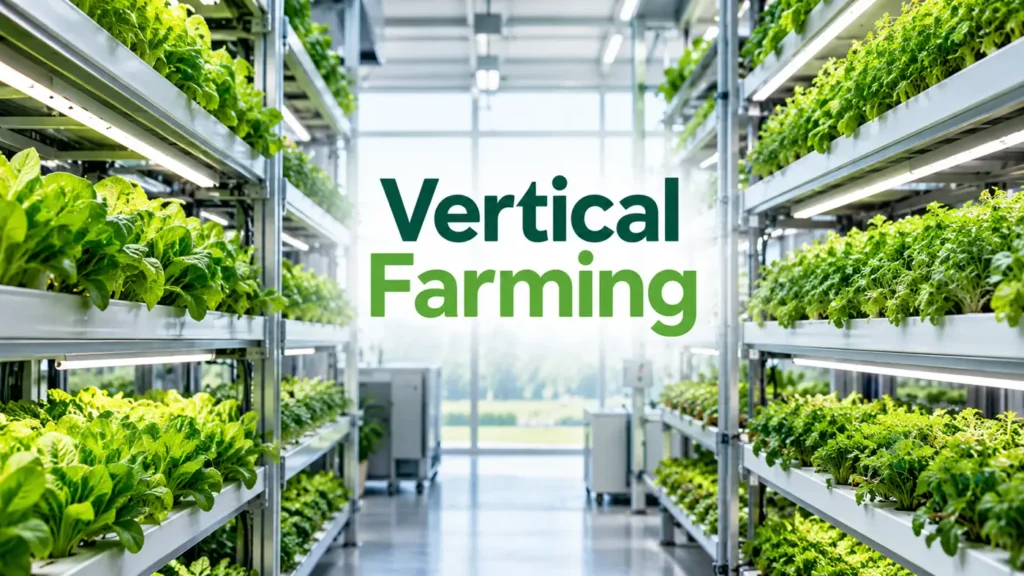
Vertical farming is an agricultural technique in which crops are grown in vertically arranged layers rather than exclusively across horizontal fields. These layers may be installed on shelves, racks, towers, or other structures designed to maximize the use of available space.
Unlike conventional farming, which is so reliant on the vagaries of outdoor weather and natural soil, many vertical farms use a controlled environment to manage temperature, humidity, light, and nutrient supply. Some systems operate entirely indoors using artificial light; others use natural sunlight in a greenhouse environment.
Vertical farming is ideally suited to certain leafy greens, herbs, microgreens, and other crops that are relatively compact and can be grown very efficiently in a small area. It’s not a method that is appropriate for all crops. Large grain crops such as wheat and rice are generally not viable for commercial vertical farming given their space requirements, their growing cycle, and their production costs.
The primary objective of vertical farming is to produce crops efficiently by combining modern agricultural practices with space-saving structures and advanced technologies.
Major Methods of Vertical Farming
Vertical farming can be practiced through different growing systems. The choice depends on the crop, available resources, production goals, and environmental conditions.
Hydroponics
Hydroponics is a method of growing plants without soil by supplying their roots with water containing dissolved nutrients. The plants may be supported by materials such as coco coir, perlite, or other suitable growing media, depending on the system.
In a vertical farm, the hydroponic system can run nutrient-rich water through a number of growing layers. This gives the grower much greater control over both the amount of nutrients and the amount of water used than is possible with many conventional growing systems.
Hydroponics is used for growing lettuce, spinach, basil, and various other leafy greens. It’s not a case of just growing the crop, though; you have to be very careful about water quality, nutrient concentration, and pH.
Aeroponics
Aeroponics is the process of growing plants with their roots hanging in an air space. The roots are fed via a fine mist or spray of nutrient solution.
This can reduce the amount of growing medium required and can be very water efficient when it’s properly designed and maintained. It does, however, require fairly sophisticated equipment, and it has to work reliably, as any interruption to the misting will have a very quick impact on the health of the plant.
Aeroponics is a specialized growing method and may not be suitable for every crop or farming operation.
Aquaponics
Aquaponics combines aquaculture, or fish farming, with hydroponic plant cultivation. In a properly managed system, nutrients from fish waste are converted by beneficial microorganisms into forms that plants can absorb. The plants take up these nutrients, helping maintain water quality for the fish.
Aquaponics can create a productive relationship between fish and plants while making use of water within an integrated system. Nevertheless, maintaining a suitable balance between fish, plants, water quality, and microorganisms requires technical knowledge and regular monitoring.
Not all vertical farms use aquaponics, as it involves additional biological and management requirements.
Benefits of Vertical Farming
Efficient Use of Space
One of the main advantages of vertical farming is its ability to produce crops in a relatively small footprint. By arranging growing areas in multiple layers, farmers can use the available space more effectively.
This can be particularly valuable in cities where there’s a lot of land under pressure and agricultural land is either very expensive or simply not available. Rooftops, warehouses and other such buildings could potentially be used for local food production, again subject to a range of structural, environmental and regulatory considerations.
Potential Water Savings
Many of the vertical farms use recirculating hydroponics or aeroponics, which means that the water is collected and reused. In those circumstances, they can use a lot less water than conventional field-grown crops.
Since water is a limited resource in many regions, this can be an important advantage. However, actual water savings depend on the growing system, crop, climate, and management practices.
Year-Round Crop Production
Traditional farming often depends on seasonal weather patterns. Heavy rainfall, droughts, extreme temperatures, and other environmental conditions can affect crop growth and yield.
Vertical farms with controlled environments can reduce their dependence on outdoor weather and support production throughout the year. This makes it possible to plan growing cycles more consistently and potentially maintain a regular supply of selected crops. Year-round production is still going to be dependent on a reliable supply of electricity, the right sort of equipment, seed availability, and good crop management.
Reduced Dependence on Pesticides
Indoor vertical farms can reduce exposure to many of the pests and diseases found outdoors, provided they are using good hygiene, good filtration, good monitoring, and good pest exclusion.
This could reduce the number of pesticide applications required. It doesn’t, however, mean that pests and plant diseases will be eliminated entirely from indoor farming. Preventive action and integrated pest management are still key to keeping crops healthy.
Fresh Produce Near Consumers
Vertical farms located close to urban markets can reduce the distance between production and consumption and thus reduce the need for transport. This would allow for the delivery of fresh produce (vegetables and herbs) to consumers in the immediate area.
Shorter supply chains can also lead to a reduction in the time between harvest and sale. The net environmental benefit will of course depend on a range of other factors including energy use, packaging, refrigeration and the mode of distribution.
Challenges and Limitations of Vertical Farming
High Initial Investment
Setting up a vertical farm can be a very capital-intensive proposition with all the associated growing structures, lighting, irrigation, climate control, sensors, and automation.
Indoor facilities will also require appropriate buildings, insulation, and backup systems. The cost of all of this can be a significant barrier to entry for small farmers and new entrants to the business.
High Energy Consumption
Artificial lighting, ventilation, cooling, heating, and dehumidification all consume a lot of electricity. In warm climates, the requirement to maintain a suitable temperature can be particularly onerous.
If it’s dependent on fossil-fuel-based electricity, then the environmental benefits may be somewhat undermined. The use of renewables, efficient lighting and well-designed climate control can all help in that regard (although at a likely higher capital cost).
Technical Knowledge and Skilled Labour
Vertical farming requires a working knowledge of plant nutrition, water management, environmental control and equipment maintenance. Small changes in temperature, humidity, nutrient concentration or lighting will all have an effect on plant growth.
Automation can improve consistency, but it doesn’t get rid of the need for skilled supervision. A piece of equipment can fail or be set up incorrectly, and that can result in crop loss. You still need to be looking after it and doing the maintenance.
Limitations in Crop Selection
Vertical farming is generally more practical for high-value, fast-growing crops that require relatively little space. Many staple crops are less economically suitable because of their growth characteristics and the resources needed to produce them indoors.
Consequently, vertical farming is unlikely to replace traditional agriculture on a large scale. Instead, it is better understood as a complementary method for producing selected crops.
Role of Vertical Farming in India
India’s agriculture is a massive undertaking which has to cope with issues of water availability, land pressure, climate variability and changing food demands. Vertical farming could be of some benefit in addressing some of those issues, particularly in the urban and peri-urban context.
Delhi, Mumbai, Bengaluru and Hyderabad all have large markets for fresh vegetables, herbs and other perishables. There is a clear potential for well-planned vertical farms in close proximity to these markets to supply some of the crops in question and thereby reduce the need for long-haul transport.
Vertical farming could also provide opportunities for agri entrepreneurs, tech providers and fresh produce businesses. The universities and research bodies can help in the development of systems that are appropriate to the local context and in the training of people in the new cultivation methods.
However, high electricity costs, capital requirements, access to finance, and what the consumer is willing to pay are all still key issues in India. Success will be down to picking the right crops, understanding the local market, and managing the operating costs.
Vertical farming should therefore be evaluated according to local conditions rather than treated as a universal replacement for conventional farming.
Future Scope of Vertical Farming
The future of vertical farming will depend on improvements in technology, energy efficiency, crop selection, and commercial management. Advances in LED lighting, automation, sensors, and data analysis may help growers monitor plant health and use resources more precisely.
AI and other digital tools can be used to monitor temperature, humidity, nutrient levels, and crop growth. They can also be used to spot problems earlier and, in turn, improve the planning of production.
The use of renewable energy and more energy-efficient facilities could strengthen the environmental case for vertical farming. Research into growing techniques and crop varieties may further improve productivity and reduce operating costs.
Nevertheless, technological progress alone will not guarantee success. Farmers and businesses must consider production costs,
The use of renewable energy and more energy-efficient facilities could strengthen the environmental case for vertical farming. Research into growing techniques and crop varieties may further improve productivity and reduce operating costs.
Technological progress in itself will not ensure success. You have to look at the cost of production, the demand from the consumer, food safety, and the environmental impact of the whole operation.
Vertical farming is most likely to become an important part of a broader agricultural system that includes conventional farming, greenhouses, protected cultivation, and other modern techniques.
FAQs about Vertical Farming
Vertical farming is an innovative form of agriculture which utilizes vertical space, controlled growing environments, and modern cultivation techniques. The potential advantages are efficient use of land, reduced water use in the right systems, and more consistent production of certain crops.
At the same time, there are the high setup costs, the power requirements, the technical complexity, and the restrictions on what crops you can grow to contend with.
In India, it could be of particular value in the production of fresh veg and herbs for the urban consumer (again, this would depend very much on the actual conditions and commercial reality on the ground). With the right research, the right technology and appropriate resource management, it could be a useful addition to the current system of farming and help to diversify our food production.