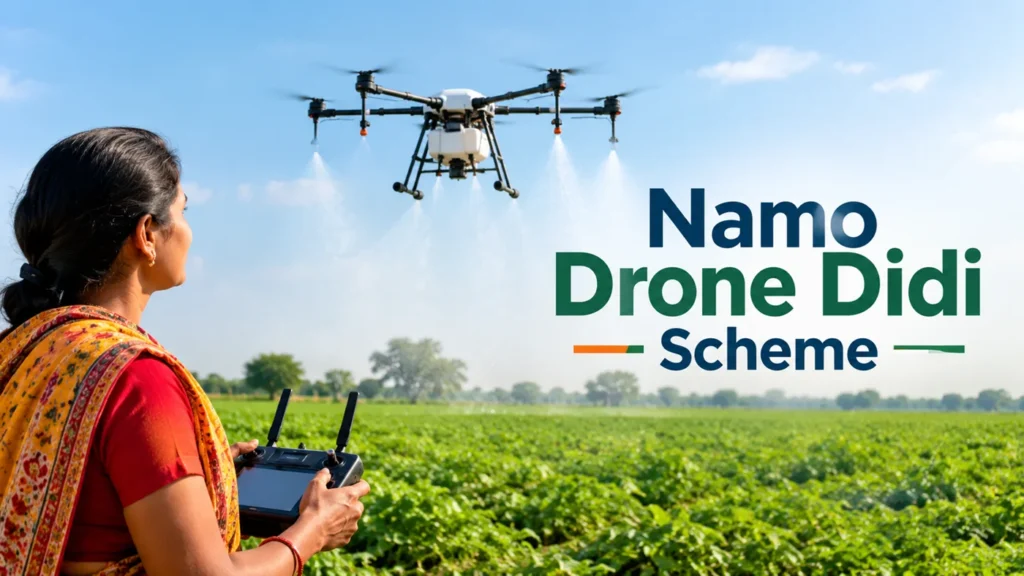
Agriculture is an important part of India’s economy, and the adoption of modern technology can help improve farming efficiency and reduce the physical effort involved in agricultural operations. At the same time, creating sustainable livelihood opportunities for rural women remains an important development priority. The Namo Drone Didi Scheme is a Government of India initiative that brings these two objectives together by providing selected women-led Self-Help Groups (SHGs) with agricultural drones.
The plan, approved in November 2023, aims to give women Self-Help Groups (SHGs) drones which they can then rent out to farmers for a variety of agricultural tasks, particularly for the application of liquid fertilisers and pesticides. As part of this initiative a spending of ₹1,261 crore is scheduled over the period 2023–24 to 2025–26, the objective being to promote agricultural mechanisation, support women’s economic empowerment and encourage the use of modern farming technologies.
Objectives of the Namo Drone Didi Scheme
The scheme focuses on introducing agricultural drone technology while creating new income-generating opportunities for rural women. Its main objectives include:
Women’s Economic Empowerment
Enabling selected women SHGs to operate drone-based agricultural service businesses and diversify their sources of income.
Modernizing Agriculture
Encouraging the use of drones for agricultural operations that can benefit from efficient and targeted application of inputs.
Supporting Farmers
Improving access to drone spraying services without requiring individual farmers to purchase expensive equipment.
Creating Sustainable Livelihoods
Helping women SHGs develop agricultural service enterprises that can generate income over time.
Promoting Efficient Farming Practices
Supporting the appropriate use of liquid fertilizers and pesticides through drone-based application.
These objectives combine technology adoption with rural livelihood development, making the scheme relevant to both agricultural modernization and women’s participation in the rural economy.
Key Features of the Namo Drone Didi Scheme
Financial Assistance for Drone Procurement
Under the scheme, selected eligible women SHGs receive central financial assistance covering 80% of the cost of the drone package, up to a maximum of ₹8 lakh.
The further procurement costs can be covered by means of eligible loans, with the scheme guidelines stating that it is possible to obtain a loan from the Agriculture Infrastructure Fund (AIF) with an interest subsidy of 3 percent, on condition that the relevant conditions are met.
This financial support is intended to reduce the initial investment required for accessing agricultural drone technology.
Provision of Agricultural Drone Packages
The scheme provides drones as a package rather than supplying only the basic aircraft. The package includes equipment and accessories required for agricultural spraying operations, such as spray assemblies, batteries, chargers, and other supporting components.
It also includes insurance, maintenance support, and training provisions. These components are intended to help SHGs operate their equipment more effectively and maintain its usability over time.
Training for Drone Pilots and Assistants
Training is an important component of the scheme because operating agricultural drones requires technical knowledge and an understanding of safe working practices.
Under the published operational guidelines, one selected SHG member receives 15 days of training, including drone pilot training and agricultural applications. Another member or eligible family member receives five days of training as a drone assistant, covering relevant support and maintenance skills.
The training is designed to help participants develop the practical skills needed to operate and support agricultural drone services.
Rental Services for Farmers
The selected SHGs are expected to use their drones to provide agricultural services to farmers on a rental basis. The principal applications covered under the scheme include spraying liquid fertilizers and pesticides.
This setup means that drone technology will become more accessible to farmers who are unable to afford buying and having a drone maintained themselves, and it also gives women SHGs the chance to earn income by offering their services to local farming communities.
Institutional and Technical Support
The scheme includes co-operation between the Department of Agriculture and Farmers Welfare, the Department of Rural Development, the Department of Fertilizers, the women’s SHGs that are taking part, and the Lead Fertilizer Companies (LFCs).
State-level committees assist in identifying appropriate areas and eligible SHGs, in assessing the demand for drone services, and in coordinating the implementation. The framework also includes provisions for monitoring the use of drones and for helping SHGs to develop viable agricultural service operations.
Benefits of the Namo Drone Didi Scheme
Benefits for Rural Women
The program can help women in rural areas acquire technical skills and take part in technology-based agricultural enterprises. The members of the SHG will gain experience in the operation of equipment, in providing services, and in business management by looking after the drone services.
The chance to make revenue from agricultural services can also lead to increased financial independence. But the amount of income obtained will depend on factors including demand, operating expenses, the use of equipment, and the ability to get customers.
Benefits for Farmers
Farmers have the possibility of getting drone spraying services without having to buy a drone on their own. In some cases, depending on the local conditions and the type of application, the use of drones for spraying may help to carry out certain agricultural operations more efficiently.
The actual benefits depend on the crop, field conditions, weather, the suitability of the equipment, and compliance with applicable pesticide and fertilizer use instructions.
Benefits for Agricultural Productivity
Agricultural drones can support the targeted application of suitable agricultural inputs and may reduce the time and manual effort required for particular spraying operations.
Nevertheless, drones are not a complete replacement for all conventional farming equipment or application methods. Their suitability depends on the specific agricultural task and the conditions in which they are used.
Benefits for Rural Economic Development
By creating opportunities for women-led agricultural service enterprises, the scheme may help strengthen rural economic activity. It also encourages the development of technical skills and the wider adoption of modern agricultural technologies.
For these benefits to be sustained, SHGs need adequate training, regular equipment maintenance, sufficient demand for services, and effective coordination with farmers.
Implementation and Progress of the Scheme
The Government approved the Namo Drone Didi Scheme with a target of providing 15,000 drones to selected women SHGs during the period from 2023–24 to 2025–26.
According to a Ministry of Agriculture and Farmers Welfare update published on 13 February 2026, Lead Fertilizer Companies had distributed 1,094 drones to SHGs during 2023–24 using their internal resources. Of these, 500 drones were distributed under the Namo Drone Didi Scheme. The government also reported that the drone recipients under the scheme had received pilot training through Remote Pilot Training Organizations authorized by the Directorate General of Civil Aviation (DGCA).
The figures show the total number of drones distributed by the companies taking part in the scheme as compared with the number that has specifically been reported under it and must not be taken as proof that the overall target of 15,000 drones has been reached.
The financial period in question concluded in 2025–26. If anyone wishes to find out about further implementation, new allocations or present opportunities, they should look at the most recent official government announcements instead of assuming that the original rollout targets or the original application arrangements have stayed the same.
How to Obtain Information About the Scheme
The Namo Drone Didi Scheme is based on choosing eligible women SHGs rather than accepting applications for direct subsidies from individual farmers.
Anyone who is interested should get in touch with the appropriate State Rural Livelihood Mission, the district rural development office, or the agriculture department to find out about their eligibility, the process for selection, and the present implementation arrangements.
FAQs about NAMO Drone Didi Scheme
The Namo Drone Didi Scheme is an attempt to link agricultural mechanization with the economic empowerment of women. It does this by giving financial help, training, and opportunities for rental services to certain women’s self-help groups, with the aim of extending access to modern farming technology while at the same time creating new sources of income in rural India.
The ongoing effectiveness of these services depends not only on equipment distribution; sustained demand for drone services, safe operating methods, sufficient technical support, and financially viable business operations are all important to maintain the benefits. If effective implementation takes place and continued support is provided, enterprises led by women can make a contribution to the modernization of farming and to the economic development of rural areas.