Agriculture plays an important role in ensuring food security and supporting economic development. With the growing global population, the demand for food production is increasing continuously. To meet this demand, farmers are adopting improved agricultural practices, modern technologies, and better-quality seeds. One important development in agriculture is the introduction of High-Yielding Varieties (HYVs) of crops. These varieties have contributed significantly to increasing agricultural productivity and improving food availability.
What are High-Yielding Varieties?
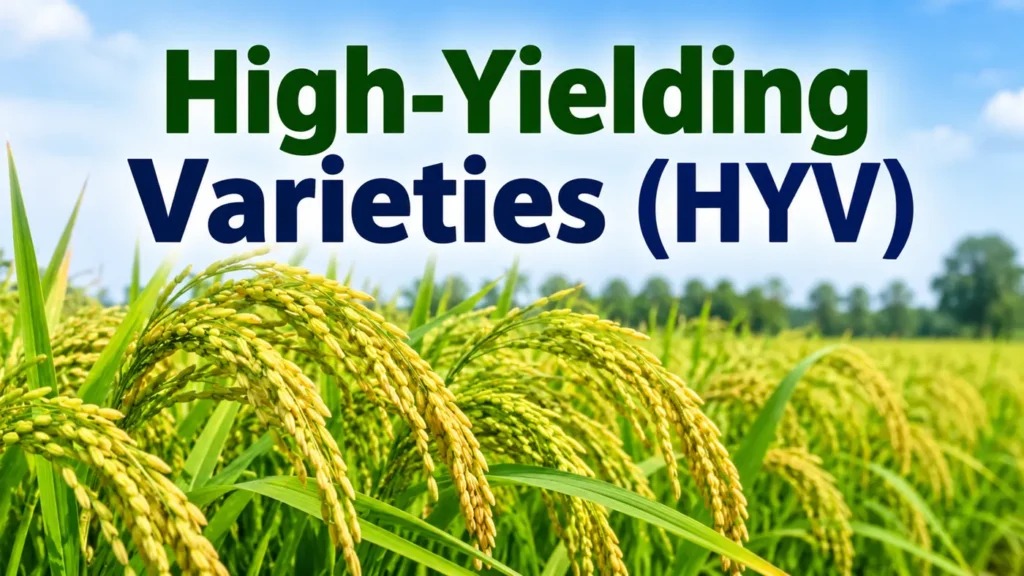
High-Yielding Varieties (HYVs) are improved crop varieties developed through scientific plant breeding to produce higher yields under suitable growing conditions compared to traditional varieties.
These varieties generally have desirable characteristics such as improved productivity, better response to fertilizers, shorter maturity periods and, in some cases, greater resistance or tolerance to specific pests, diseases and environmental stresses.
HYVs have been of great significance in the modernization of agriculture, particularly in developing countries such as India, where there has been a constant need to increase food production to meet the demands of a growing population.
Importance of High-Yielding Varieties in Agriculture
High-yielding varieties are important for improving agricultural production and strengthening food security. Their importance can be understood through the following points:
- Increased Crop Production: HYVs help farmers obtain higher yields from the same area of agricultural land under appropriate conditions.
- Improved Food Security: Higher crop production contributes to greater food availability and helps meet the increasing demand for food grains.
- Efficient Use of Resources: Many HYVs respond well to improved irrigation, fertilizers, and other agricultural inputs.
- Shorter Crop Duration: Some improved varieties have shorter maturity periods, allowing farmers to grow multiple crops in a year where conditions permit.
- Better Farm Income: Higher yields can increase farmers’ earnings, provided production costs and market conditions remain favorable.
Examples of High-Yielding Varieties of Crops
Several high-yielding crop varieties have been developed to improve agricultural productivity. Some examples include:
- Wheat: Varieties such as HD 2967 and HD 3086 have been developed for improved wheat production in India.
- Rice: Varieties such as Swarna and Pusa Basmati 1121 are examples of improved rice varieties cultivated in different regions.
- Maize: Improved varieties and hybrids such as HQPM-1 have been developed to increase maize productivity.
- Pulses: Varieties such as Pusa 372 in chickpea and Pusa 2002 in pigeonpea are examples of improved pulse varieties.
The suitability of these varieties depends on factors such as climate, soil conditions, irrigation facilities, and regional recommendations.
Role of High Yielding Varieties in the Green Revolution
High-yielding varieties played a major role in India’s Green Revolution, which began during the 1960s. The introduction of improved wheat and rice varieties, combined with irrigation facilities, fertilizers, pesticides, and modern farming techniques, helped significantly increase food grain production.
Scientists such as Dr. M. S. Swaminathan contributed greatly to the development and promotion of improved agricultural practices in India. The adoption of HYV seeds helped the country increase its wheat and rice production and reduce dependence on food grain imports.
The Green Revolution transformed Indian agriculture, particularly in states such as Punjab, Haryana, and western Uttar Pradesh.
Benefits of High-Yielding Varieties
High-yielding varieties offer several benefits to farmers and the agricultural sector.
- Higher Productivity: They can produce greater quantities of crops per unit of land under suitable conditions.
- Improved Quality: Some improved varieties offer better grain quality, nutritional characteristics, and market value.
- Multiple Cropping: Short-duration varieties can help farmers fit additional crops into the agricultural calendar.
- Economic Development: Increased agricultural production can support farmers’ incomes and contribute to the rural economy.
- Technological Advancement: HYVs encourage the adoption of scientific farming practices and improved agricultural technologies.
Challenges Associated with High Yielding Varieties
Some varieties require adequate irrigation, balanced fertilizer application, and proper crop management to achieve their yield potential. Excessive dependence on a limited number of crop varieties can also reduce agricultural biodiversity.
In addition, continuous intensive cultivation may contribute to soil degradation and increased pressure on groundwater resources if natural resources are not managed properly. Some improved varieties may also be vulnerable to particular pests or diseases.
Farmers should therefore select varieties appropriate to their own local conditions and follow the recommended agronomic practices.
FAQs about High-Yielding Varieties
High-yielding varieties have been a major force in the transformation of modern agriculture, increasing productivity and contributing to food security. The role they played in India’s Green Revolution is a case in point as to how much value can be derived from research and improved seed varieties. Their success in adoption, of course, depends on a number of things, including appropriate resource management, appropriate agronomic practices, and the conservation of crop diversity. The promotion of improved and climate-resilient crop varieties is key to building a productive and sustainable agriculture of the future.