Agriculture is not limited to growing food crops; it also includes the cultivation of plants for decorative, commercial, and aesthetic purposes. Floriculture is an important branch of horticulture that focuses on the cultivation, management, and marketing of flowering and ornamental plants. With the growing demand for flowers in celebrations, decoration, landscaping, and the perfume industry, floriculture has emerged as a valuable commercial activity. It also provides employment opportunities and contributes to the growth of the agricultural economy.
What is Floriculture?
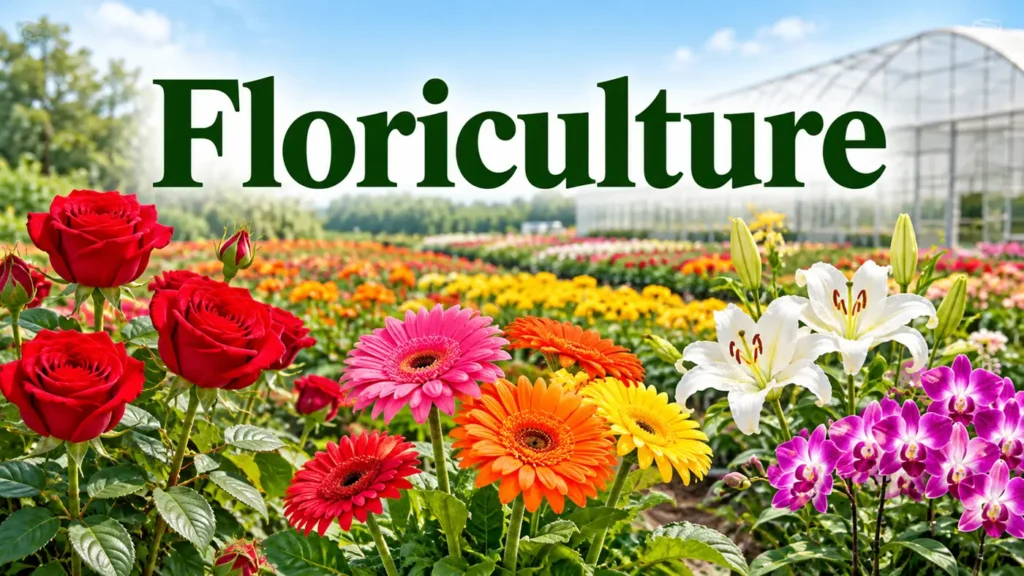
Floriculture is a branch of horticulture that deals with the cultivation, production, and commercialization of flowers and ornamental plants. It includes growing cut flowers, loose flowers, flowering plants, foliage plants, and other decorative plant varieties.
Floriculture covers a whole range of activities from seed selection and propagation through to planting, irrigation, fertilizing, pest control, harvesting, packaging, and marketing. The flowers produced in this way are used in a number of different ways: in bouquets, for religious purposes, for weddings, in landscaping, in the decoration of interiors, and as the source of essential oils and perfumes.
In India, floriculture is practiced both on a small scale by individual farmers and on a commercial scale using modern cultivation techniques such as greenhouse farming and protected cultivation.
Types of Floriculture
Floriculture includes several categories based on the purpose and method of flower production.
1. Cut Flowers
Cut flowers are grown specifically for harvesting their stems, flowers, and buds for decorative purposes. They are commonly used in bouquets, floral arrangements, weddings, and other celebrations. Examples include roses, carnations, gerberas, orchids, and chrysanthemums.
2. Loose Flowers
Loose flowers are picked without their stems and are generally used in religious ceremonies, garlands, decorations, and for traditional festivities.
Examples include marigold, jasmine, tuberose, and chrysanthemum.
3. Ornamental Plants
Ornamentals are grown for their flowers, their foliage, their form, and their general appearance. They’re used in gardens, parks, in the home, in the office, and in all sorts of landscaping.
Examples include hibiscus, bougainvillea, crotons, and a number of flowering shrubs.
4. Bulbous Flower Crops
These are flowering plants grown from specialized underground storage organs (bulbs, corms, and tubers). They’re grown for their flowers and for commercial purposes.
Examples include tulips, gladiolus, lilies, and tuberose.
Important Flowers Grown in Floriculture
Several flowers are cultivated commercially because of their popularity and market demand.
- Rose: Widely grown for bouquets, decoration, perfumes, and essential oil production.
- Marigold: Used in garlands, for religious ceremonies, and for decoration at festivals.
- Jasmine: Grown for its fragrance and used in perfumery, in garlands, and in traditional rituals.
- Gerbera: A very popular cut flower, mainly because of its color and long vase life.
- Chrysanthemum: Used in bouquets, floral arrangements, and ornamental gardening.
- Orchid: Valued for its very particular appearance and used in floristry and in the commercial flower market.
- Carnation: Grown widely for use in bouquets and as a floral decoration.
Methods of Floriculture
Farmers use different cultivation methods depending on the flower variety, climate, available resources, and market requirements.
1. Open Field Cultivation
In this method, flowers are grown directly in agricultural fields under natural environmental conditions. It is commonly used for flowers such as marigold, jasmine, and chrysanthemum.
2. Greenhouse Cultivation
Greenhouse growing is the practice of growing flowers in a structure covered in glass or some form of transparent plastic. It enables the farmer to control the temperature, the humidity, the light, and all the other environmental factors.
This method is particularly useful for cultivating high-value flowers such as roses, gerberas, and carnations.
3. Hydroponic Cultivation
Hydroponics is a method of growing plants without soil, using nutrient-rich water solutions. Certain flowers can be cultivated through hydroponic systems, allowing better control over nutrient supply and growing conditions.
4. Protected Cultivation
Protected cultivation involves growing the flowers in a range of structures such as polyhouses, shade nets, and greenhouses. The aim of this is to protect the crop from adverse weather, pests, and excessive sun.
Importance of Floriculture in Agriculture
Floriculture plays an important role in agricultural diversification and rural economic development.
- Income Generation: Commercial flower cultivation can provide farmers with an additional source of income.
- Employment Opportunities: It creates jobs in growing, harvesting, packing, transporting, arranging, and marketing.
- Agricultural Diversification: Enables the farmer to move beyond the traditional food crop and get into other high-value agricultural activities.
- Export Opportunities: There is commercial demand for flowers and ornamental plants in the international market, so there are export opportunities.
- Environmental Benefits: Provides habitat and food for pollinators (bees, butterflies, etc.) and can be a contributor to biodiversity if grown correctly.
- Development of Allied Industries: Floriculture supports related industries such as perfumes, essential oils, landscaping, event decoration, and nursery management.
Benefits of Floriculture
Floriculture offers several economic, commercial, and environmental benefits.
- High Commercial Value: Certain flowers can generate attractive returns due to their demand in domestic and international markets.
- Efficient Land Utilisation: Flower cultivation can provide an alternative use for suitable agricultural land, including relatively small plots.
- Growing Market Demand: Flowers are used in weddings, festivals, religious ceremonies, hospitality, and interior decoration.
- Supports Rural Development: There is an opportunity for small farmers, small entrepreneurs, and rural workers in the area through commercial flower production.
- Promotes Entrepreneurship: Floriculture encourages businesses such as flower nurseries, bouquet-making services, landscaping, and floral design.
Challenges in Floriculture
Despite its commercial potential, floriculture also faces several challenges.
- Perishable: Flowers have a finite shelf life and need to be handled with care after picking.
- Weather Dependence: Flower quality and output can be affected by extreme temperatures, heavy rain, and the odd bit of weather we can’t always predict.
- High Initial Investment: Greenhouses, irrigation, planting material, etc. can all be expensive.
- Storage and Transportation: Flowers need appropriate packaging, temperature control, and rapid transport to keep them fresh.
- Market Fluctuations: Prices may change depending on seasonal demand, festivals, production levels, and market conditions.
- Pest and Disease Management: Flower crops can be affected by various pests and diseases, requiring proper crop protection measures.
Scope of Floriculture in India
India has enormous potential for floriculture given the range of climatic conditions, the availability of agricultural labor and the rising domestic demand for flowers.
Karnataka, Tamil Nadu, Andhra Pradesh, West Bengal and Maharashtra are all major floriculture producing states.
The sector is also benefiting from the increasing use of greenhouse production, better planting material, modern irrigation and organized flower marketing. Government schemes and the backing of agricultural bodies can go a long way towards encouraging farmers to move into commercial flower production.
FAQs about Floriculture
Floriculture is a major arm of horticulture which is at the same time an agricultural activity and a commercial/decorative activity. It is a source of income, employment, diversification of agriculture, and rural development. There are, of course, challenges in the form of perishability, transportation, and market fluctuations, but the sector can be strengthened through better cultivation practices and better post-harvest management. With the increasing demand for flowers and ornamental plants, the sector has a great deal of potential to contribute to the agricultural and economic development of the country.