
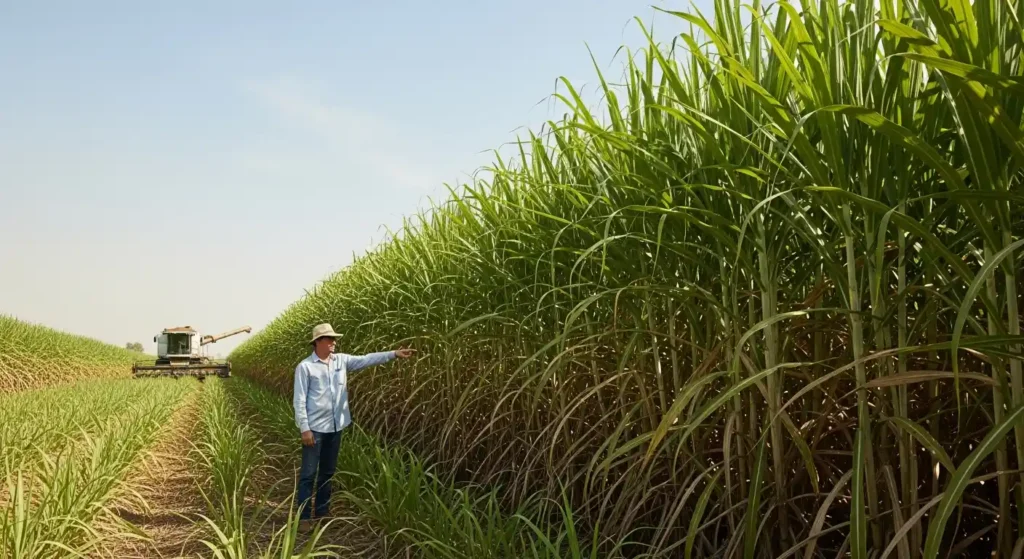
Sugarcane is one of the key commercial crops in India which is grown by farmers in many states of India. When the crop gets proper growing conditions such as good seed-cane, appropriate soil, fertilization, watering, weed control, pest management and harvesting, sugarcane can yield well.
But, sugarcane is a long-duration crop. Any mistake in soil preparation and sowing can have an adverse impact on the crop for months to come. The beginner farmer needs to pay less attention to application of extra fertilizer or water and more on basic management practices.
Here is a complete guide on sugarcane farming tips in easy language. This guide includes everything from selecting the field, selection of seedcane, irrigation, fertilization, weed control, pest management, ratoon management and harvesting.
The exact suggestions may vary with variety, weather conditions, soil and the state itself. For example, ICAR’s sugarcane advisory varies with the region rather than taking all sugarcane growing regions in India together.
1. Selecting the right land for sugarcane cultivation
The first step in successful sugarcane production is land selection.
Sugarcane tends to grow well in deep, fertile, well-drained soils with high water-retention capacity. It does not perform well where there are standing water conditions. The most recent agro advisory of ICAR recommends well-drained deep loam soils and warns against saline or alkaline soil condition.
It needs to be assessed before planting,
- Soil texture
- Soil pH
- Organic matter
- Drainage
- Available irrigation water
- Major nutrients
- Previous crop history
Soil test is especially useful for a new grower as fertilization cannot only depend upon what other farmers use.
Simple fact: Successful sugarcane production begins from proper soil, not from extra fertilizer.
2. Choose Suitable Sugarcane Varieties
The selection of variety can have an effect on yield, maturity period, disease resistance, and ratooning.
Do not choose any variety only because some other farmer had good yields with it. A variety that is suitable for one region may not be suitable for the other.
You should choose varieties suitable for your:
- State/region
- Type of soil
- Planting season
- Availability of irrigation
- Sugar factory in the locality
- Maturity period you expect
- Diseases/pests condition
Recently, ICAR-Sugarcane Breeding Institute has emphasized the use of improved varieties and the varieties like Co 18009, Co 11015 and Co 14012 have been recommended by the institute.
Recommendations for local varieties are necessary because sugarcane varieties are constantly improving.
3. Use Good Quality Planting Material
One of the top sugarcane cultivation tips for new farmers is not to take any compromise with respect to the quality of seed cane.
Sugarcane is generally planted using cuttings known as setts. Poor quality planting material can cause poor germination and problems related to diseases.
Some good quality planting material is:
- Healthy and free from diseases
- True to variety
- Free from pests’ injuries
- Matured enough
- Of reliable sources
ICAR has stressed the need of genetically pure, virus and disease-free planting material in sugarcane cultivation.
According to ICAR’s recent guidelines, the healthy 9-10 months old canes should be used and top third portion should be taken for the setts in concerned production system. It has given a seed requirement of 45,000-50,000 three-budded setts per hectare, or 6-8 tons, depending on the type of plantation.
4. Treatment of Setts Before Plantation
Use of unset treatment may lead to introduction of diseases into a new plantation site.
Methods of sett treatment differ based on the geographical location and disease condition in the area. For example, ICAR’s 2025 guideline has described the process of fungicide treatment of setts before planting.
Farming practices should be based on the sett treatment method prescribed by the concerned authorities, such as local agricultural department or sugar factory and not the chemical dosage used in another place.
General principles are quite easy:
Healthy seed + good sett treatment = Better chance of uniform germination.
In cases where it is advised, use of modern planting materials such as buds and tissue culture seedlings or other methods of seed multiplication will further help in reducing requirement of the planting material.
5. Make Field Preparation Right
Proper land preparation creates room for root development and facilitates easy irrigation and field operations.
The land preparation may involve:
- Clearing residues and weeds of the previous crop.
- Ploughing deeply if necessary.
- Breaking of large soil clods.
- Field leveling.
- Organic manure application depending on the soil and farming requirement.
- Creation of right trenches or beds.
- Ensure water can easily drain from the field.
The ICAR guide for sugarcane cultivation up to the year 2025 suggests deep ploughing, harrowing, weed removal, and field leveling and drainage.
Do not make your field water-retentive after heavy rains. Sugarcane requires water, but waterlogging does not mean proper irrigation.
6. Ensure Proper Planting Spacing
Proper spacing can make a difference in how well the crops utilize sun, moisture, and nutrients.
The spacing considerations include:
- Cultivar
- Soil
- Watering
- Planting technique
- Use of machinery
- Local guidelines
According to the latest ICAR guidance, some of the spacings include 90 cm in the case of unirrigated cultivation, 120 cm when irrigation or paired row trench methods are used, and 60 cm for high density planting.
It is important not to take the above values as the single standard.
For beginners, the right thing to do is to plant at the spacing advised for the particular cultivar and planting method.
7. Look at Trench, Paired-Row or Improved Methods of Planting
Flat or furrow planting may not always be the method to follow.
Based on their local conditions, farmers may consider:
- Paired-row planting
- Trench planting
- Raised bed furrow irrigation
- Ring-pit planting
- Mechanical planting
- Bud chip planting
With better management, such methods help in better utilization of resources and ease of operations.
ICAR studies have pointed out trench, FIRB, and ring-pit methods together with seed multiplication methods as modern sugarcane cultivation methods.
But avoid adopting any new method just because it is advertised as “modern.” Know the cost, machinery requirements, labor requirement, and local results first.
8. Irrigate Carefully
Water is one of the most important considerations in sugarcane cultivation.
While sugarcane requires adequate water throughout its growth phases, irrigation must be done depending on the soil, climate, stage of crop development, and water content.
In the early growing phase, the idea is to ensure adequate moisture in the soil for germination without flooding the farm constantly.
According to TNAU, there are shorter irrigation intervals in germination and other intervals in tillering, grand growth, and maturation, with sandy soil needing more irrigation than heavy soils.
What matters is that not any one irrigation schedule will suit all farms.
Practical considerations
Check:
- Water in soil
- Climate/temperature
- Rains
- Stage of growth of crop
- Type of soil
- Method of irrigation
Under hot and dry conditions, water requirement could increase sharply. Therefore, local advice on irrigation schedule would apply.
9. Opt for Drip Irrigation Where Feasible
For those farmers who have appropriate facilities for irrigation, drip irrigation may be a very useful means for water management.
Drip irrigation can help in delivering water to the root zone and fertigation may also be used.
In the case of sugarcane, TNAU gives suggestions on paired row drip irrigation and fertigation where nutrients are applied in several stages instead of once.
However, drip irrigation may not necessarily be profitable in every case.
Before installing the drip system, it should be calculated as follows:
- Installation cost
- Subsidy, if any
- Water availability
- Power cost
- Water savings
- Yield increase
- Maintenance cost
It must be remembered that the well-maintained irrigation system will be much more helpful than an expensive but ill-maintained system.
10. Do Not Exceed Fertilizer Amount
Although sugarcane is nutrient-intensive, additional fertilizer does not always imply additional sugarcane.
Excessive use of nitrogen, for instance, may promote excessive growth and fail to deliver the anticipated financial benefit.
The fertilization strategy should be determined by:
- Soil analysis
- Sugarcane variety
- Sugarcane yield
- Whether plant cane or ratoon cane
- Soil fertility
- Irrigation method
- Local guidelines
In TNAU nutrient guidelines, there is an emphasis on multiple fertigation doses of nitrogen and potassium in drip irrigation method.
For the novice grower, the best practice is to apply fertilizer during the crop development stages, and not to do all at once when planting the crop.
11. Add Organic Matter to the Soil
Organic matter is known for helping to build soil structure, improving its capacity to hold water, and providing biological benefits.
Depending on availability, farmers may apply any of the following organics, provided that it is well-decomposed:
- Farm yard manure
- Compost
- Green manure
- Crop residues
- Other relevant organic materials
Organic matter must be used in conjunction with a proper nutrient management system.
Those farmers who are keen on sustainable sugarcane cultivation might benefit from using a combination of soil analysis, organic matter management, efficient irrigation, and fertilization.
12. Weed Control
Weeds compete with sugarcane for:
- Water
- Fertilizers
- Sunlight
- Land
This competition may prove most harmful when the crop is still at a young stage.
Keep the land weed-free in the initial stages of crop growth.
Some options are:
- Hand weeding
- Use of machinery
- Mulching
- Waste management
- Herbicides as per local recommendations
The use of herbicides depends on local suggestions and according to the directions provided by manufacturers.
ICAR and agricultural universities provide information regarding weed control under different cropping systems, so it is better to follow local recommendations.
13. Management of Sugarcane Trash
After harvest, sugarcane trash does not necessarily need to be considered waste.
Properly managed trash may help in:
- Reducing soil moisture loss
- Controlling weeds
- Improving organic content in the soil
- Prevention of soil erosion
- Soil improvement
Sugarcane trash management should also be compatible with the local pest and disease management as well as ratoon cultivation practices.
Instead of unnecessarily burning crop residues, try using it for the good of your farm, if possible.
14. Inspect for Pest and Disease Monitoring
Do not wait until your whole field is affected.
Move around your field and inspect:
- Leaves
- Stems
- Shoots
- Roots
- Shoots
- Plant gaps
Look out for anything abnormal such as leaves of unusual color, dead shoots, holes, tunneling, wilting or poor growth.
In most cases, integrated pest management would be better than pesticide application based on a fixed schedule.
This method includes:
- Monitoring
- Proper diagnosis
- Use of resistant variety if any
- Sanitation of field
- Biological control or cultural control if feasible
- Chemical control if necessary and recommended locally
Using healthy planting material is also important for disease prevention. The ICAR has repeatedly stressed the importance of using healthy seed cane.
15. Take Care of the Ratoon Crop
One benefit of cultivating sugarcane is that a ratoon crop can always follow the first crop since new cane grows from the stubble.
However, a bad first crop doesn’t always guarantee a good ratoon.
Post-harvest:
- Retain healthy stubble
- Trim away diseased stubble if needed
- Maintain moisture in soil
- Add nutrients based on soil condition
- Eliminate weed infestation at an early stage
- Pest and disease inspections
- Maintain proper crop establishment
The ratoon crop management should start right after harvesting without waiting several weeks.
16. Inter-Cropping is Possible If Appropriate
Considering the fact that the sugarcane remains in the field for a long time, the farmers might think of adopting inter-cropping during the early stages.
Proper inter-crops largely depend upon:
- Location
- Season of planting
- Plant spacing
- Water requirement
- Soil type
- Market
- Labour availability
ICAR has also pointed out sugarcane based inter-crop cultivation system such as sugarcane + maize as a practice currently being researched for resource use and additional income.
Intercropping is not advisable when there is heavy competition between companion crops for water, nutrients or sunlight.
17. Plan Harvesting Before the Crops Become Matures
Many inexperienced producers consider harvest planning only at the time when they see the crops becoming mature.
In fact, it is better to plan ahead.
Take into account:
- Planned maturity date
- Cultivar
- Local harvest period
- Availability of labour
- Transport
- Sugar mill calendar
- Weather conditions
- Payment terms
Sugarcane may stay in the field for about 10–15 months depending on the production technology and region. According to the recent advice of ICAR, 12-15 months is required by the certain kharif system.
The earlier or later harvest affects crop value, therefore, pay attention to local maturity criteria and sugar mills requirements.
18. Cut Down Labour Cost through Mechanization
Labour may turn out to be one of the largest expenses of sugarcane growing.
Economically feasible mechanization technologies should be considered for:
- Land preparation
- Planting
- Inter-cultural operations
- Fertilizing
- Harvesting
- Loading
- Transport
ICAR-Sugarcane Breeding Institute gives special emphasis to mechanization in order to cope with labour shortage problem, particularly, mechanization of a significant part of sugarcane cultivation.
There is no need for small farmers to buy each machine for themselves. There are such alternatives as custom hire centers, farmers unions and machinery banks.
19. Maintain Farm Records
This is perhaps the easiest yet most ignored sugarcane farming tip.
Maintain a record of:
- Variety of sugarcane grown
- Date of plantation
- Quantity of seeds
- Fertilizer used
- Date of irrigation
- Labour cost
- Machinery cost
- Cost of pest and disease control
- Harvesting date
- Yield
- Selling price
- Total cost of production
Once you harvest, determine your actual profit.
The reason is to find out the following:
Is the crop yielding much or does it yield well?
A farmer who keeps records will be able to compare the varieties, methods of planting and irrigation systems from one year to the next.
20. Concentrate on Yield and Sugar Recovery
Sugarcane farming is not just a matter of producing a lot of sugarcane.
It is also important for those who are growing it for the sugar-mill to get quality cane with sugar recovery.
Thus proper crop management would result in:
- Healthy cane
- Proper maturity
- Proper variety growth
- Good nutrition management
- Water management
- Reduced disease pressure
- Harvesting at the right time
According to ICAR, increase in farmer income depends on the increase in sugarcane production and sugar recovery as well as reduced cost of production.
Simple Guide for SugarCane Farming Tips
Prior to planting:
- Soil test.
- Choose a variety recommended locally.
- Purchase healthy planting material.
- Ensure land preparation is done.
- Arrange drainage and irrigation systems.
- Plan on how to plant the crops.
At planting time:
- Use healthy setts.
- Familiarize with the recommended sett treatments locally.
- Ensure uniform spacing.
- Ensure good soil contacts.
- No unnecessary standing water.
In crop growth period:
- Irrigate the crops based on their requirement.
- Weed control should be early.
- Apply nutrients based on soil and crops.
- Pest and disease control measures should be taken.
- Organic waste management.
- Keep farm records.
Prior to harvest:
- Ensure that crops have matured.
- Coordinate with sugar factory, if any.
- Labour arrangement.
- Transport arrangements.
- No delay after harvest.
Mistakes Farmers Making in Sugarcane Plantation
- Utilizing cheap and unproductive seed cane
Cutting costs through utilizing planting material can lead to greater complications down the road.
- Following another person’s fertilizer calendar
The nutrients needed for the crops are not the same as the soil type.
- Irrigating more than needed
Sugarcane requires water, but irrigating too much is bad for roots and increases chances of getting diseases.
- Not focusing on drainage
Good irrigation should coincide with good drainage.
- Allowing weeds during early stages
Weeds competing with crops during their establishment phase is counter-productive.
- Identifying pests late
Field inspection regularly will be better than identifying pests when the losses have become great.
- Neglecting the ratoon crop
Ratoon crops need good management right after harvest.
- Only focusing on yield
A productive field doesn’t always mean it is profitable.
- Disregarding mechanization
For places where labor is costly and lacking, custom and sharing machinery is an alternative.
Concluding Thoughts: Sugarcane Farming Tips
Good sugarcane cultivation is not about implementing one “secret” method, but rather about making numerous small decisions right.
Select the appropriate variety. Begin from high-quality planting material. Ensure good soil preparation. Provide the plant with necessary water and avoid unnecessary irrigation. Apply fertilizer depending on the type of the soil and the crop. Manage weeds timely. Keep an eye on pests and diseases. Utilize organic material and crop residue wisely. Think of drip irrigation, enhanced planting and mechanization where economically viable.
The most important thing here is to treat sugarcane farming as a business, not only as a crop. Account for expenses you have incurred, evaluate your crop’s productivity and learn about your market while comparing various farming practices’ performance.
For starters, it is the best to rely on local recommendations and gradually improve them. New farming technologies like high-quality seed production, enhanced varieties, drip fertigation, mechanization and improved planting system can be employed depending on the particularities of your farm.
Eventually, the optimal farming strategy for sugarcane would be a balanced approach that takes into account yield, sugar quality, water consumption, soil quality, labor intensity and cost of production.
FAQs: Sugarcane Farming Tips
What is the primary sugarcane cultivation advice for starters?
It is critical to begin with healthy plant material and the right variety of sugarcane. Substandard seed cane can negatively influence crop establishment right away.
How much water do you require for sugarcane?
Each farm has its unique water requirements, depending on soil type, climate, the phase of crop growth and irrigation system.
Which soil type is the most appropriate for sugarcane?
The soil should be deep, fertile, well-drained and have excellent water retention capacity. You should test your soil prior to planting.
Is it good to use drip irrigation for sugarcane?
Drip irrigation can be used effectively, especially when water and fertilizer application play an important role. The profitability of the system depends on many factors like the cost of installation, water supply, the size of farm and other factors. TNAU has drip and fertigation systems for sugarcane.